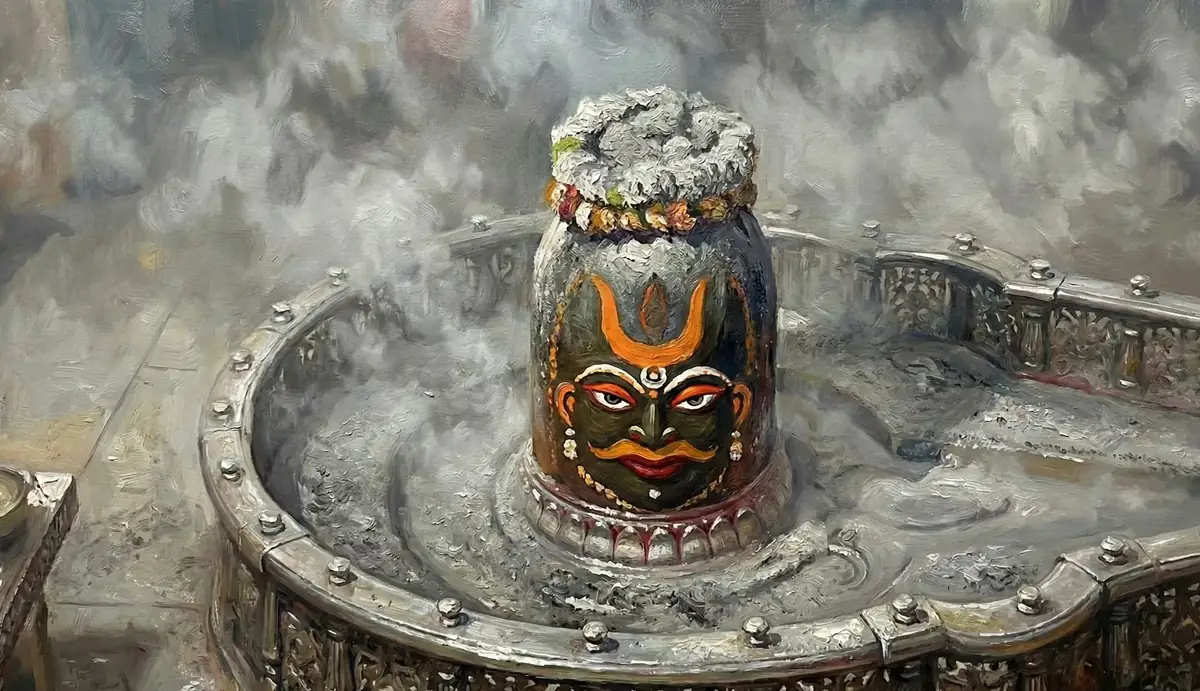
What is the Bhasma Aarti — and why it exists nowhere else
At four in the morning, while the rest of India sleeps, the sanctum of Shri Mahakaleshwar in Ujjain fills with conch, damaru and Vedic chant, and sacred ash is offered to the only south-facing Jyotirlinga on earth. Devotees plan entire journeys — sometimes entire years — around this single pre-dawn hour. This page tells you exactly what you will witness, how to get a seat the official way, what it costs, what to wear, and how to turn one aarti into a complete Ujjain pilgrimage.
The meaning of Bhasma Aarti in one paragraph
Of the twelve Jyotirlingas, Mahakaleshwar alone is Dakshinamukhi — facing south, the direction that tradition assigns to Yama, the lord of death. And Mahakal alone receives bhasma, sacred ash, as his first offering of the day. The symbolism is deliberate: everything that time touches — wealth, kingdoms, the body itself — ends as ash. By adorning the Lord of Time with ash, the ritual declares that he alone stands beyond it. Sitting before that declaration at 4 AM is why pilgrims weep here. It is not theatre; it is philosophy performed.
The legend behind the ash
The Puranic account tells of Dushana, a demon who tormented the devout of ancient Avantika (today's Ujjain) and outlawed the worship of Shiva. When a Brahmin family prayed on regardless, the earth split and Shiva erupted as Mahakal — the Great Time — reducing the demon to ash with a single breath. At his devotees' plea he remained in Ujjain forever as the Jyotirlinga. The daily ash offering commemorates both the victory and the promise: the Lord who turned evil to ash now wears ash as his ornament, and his city keeps time for the world. Ujjain sits on the ancient prime meridian of Hindu astronomy — the town where time itself was once measured has, as its guardian, Time itself.
What happens inside, minute by minute
The doors of ordinary time close around 3:30 AM as the hall fills. Then, in a sequence that has not changed in living memory: the jal-abhishek and bathing of the linga with water, milk and panchamrit as the sanctum lamps multiply one by one; the shringar — sandal paste, vermilion, flowers and silver ornaments built and rebuilt with astonishing speed by the pujaris; then a change in the drums. The bhasma moment itself is brief — minutes, not the whole aarti — a storm of ash, conch and damaru that no camera could hold anyway. After it the adornment is completed on the ash-dark linga, arati flames circle, and the hall sings. By 6:00 AM the doors reopen and you walk out into a sunrise that feels earned.
Seated pass vs. standing (chalit) darshan
There are two ways to be present at the Bhasma Aarti hour, and understanding the difference saves both money and heartbreak. A seated permission — booked on the official portal for about ₹200 — places you inside the hall for the entire ritual. The chalit darshan is a moving queue that passes the sanctum viewing during the aarti hour; it is free, needs no booking, and offers a genuine glimpse rather than a seat. Agents who sell "guaranteed seats" for thousands of rupees are selling one of these two things — usually the free one, rebranded.
Seated permission (~₹200)
Inside the hall for the full two hours. Named, ID-locked, biometrically checked. Booked only on shrimahakaleshwar.mp.gov.in. Dhoti / saree required.
Chalit darshan (free)
Moving darshan past the sanctum viewing during the aarti hour. No booking, no seat, ordinary modest clothing. Ask the guards for the chalit line that morning.
Who should witness it
Everyone who can wake at 1:45 AM. Elders with knee trouble should read the seating advice further down; families with children should read the night-before plan; solo women travellers will find Ujjain at 2:30 AM one of the busier, better-lit late nights in India. The only people who should skip the seated aarti are those who cannot sit on cold stone for two hours — and even they should take the chalit darshan, then return for the calmer 6 AM general darshan.
What the pujaris actually do — the ritual, decoded
Understanding the sequence turns two hours of spectacle into two hours of meaning. The aarti is performed by the temple's hereditary pujari families under the administration's arrangements, and each stage has a name devotees hear chanted. Jal-abhishek — the linga is bathed with water from sacred sources, then milk, curd, honey, ghee and sugar (the panchamrit), each poured with its own mantra. Shringar — the wet linga is dried and dressed: sandal paste, vermilion, bhang in some seasons, flowers, silver ornaments, a serpent crown; the pujaris work with a speed and precision that comes only from performing it every morning for decades. Bhasma — the sacred ash is offered as the drums shift to a faster rhythm; this is the moment the hall has waited for, and it lasts minutes. Arati — the flames are circled before the ash-dark form while the hall sings the Mahakal arati; conch, damaru and bells peak here. Dhoop and prasad — incense, the final offerings, and the slow opening of the doors of ordinary time. Devotees who know these five words follow the aarti like a story instead of watching it like a show.
The Bhasma Aarti through history
The ash offering is described in Sanskrit texts about Mahakal and in the accounts of pilgrims across centuries, but the modern form — a permission-based seated ritual for several hundred devotees — is a product of the last decades, as Ujjain's pilgrim numbers rose from thousands to lakhs. The temple's administration moved from paper permissions issued at the counter to the online portal, then to biometric verification at the gates, largely to kill the black market in passes that had grown around the ritual. That history explains today's rules: the name-locked pass, the ID check, the phone ban and the 8 AM release are each a response to a specific problem that once made the aarti a lottery for the honest and a business for the rest. Knowing why the rules exist makes them easier to keep.
Bhasma Aarti by the numbers
- 365 — mornings a year the aarti is performed; it has no holiday.
- ~4:00 to ~6:00 AM — the standard window; earlier in Sawan, rearranged on Mahashivratri.
- 2:30–3:00 AM — when pass-holders should be at their gate.
- ~₹200 — the official per-person online permission fee (indicative).
- 8:00 AM on the 1st — when the next month's seats release; ~1 day before, 8 AM — the Tatkal quota.
- 0 — the number of agents the temple has. A seat not booked in your name against your ID does not exist.
Feelings, honestly described
First-timers describe three things in the same order. First, the cold — the hall floor is stone and the winter dawn in Ujjain drops near 5–10°C. Second, the silence before the conch — thirty minutes in a waking temple that many devotees later call the most powerful part of the whole night. Third, the moment the drums change and the ash rises, when several hundred strangers exhale at once. Nobody films it (phones are in the cloakroom), which is precisely why it stays with people.
Bhasma Aarti time, temple timings and the five aartis of Mahakal
The Bhasma Aarti begins at about 4:00 AM and runs until roughly 6:00 AM, every single day of the year. Pass-holders report at their gate by 2:30–3:00 AM. During Sawan (Shravan) the ritual traditionally shifts earlier, commonly toward 3:00 AM. One honest caveat governs every timing on this page: they are set by the temple administration, they shift with seasons and festivals, and the official portal's word always beats ours.
The official aarti schedule — two seasons
The temple publishes its aarti timings in two seasonal schedules on the official portal's timings page. The Bhasma Aarti and the Shayan Aarti are fixed all year; the three daytime aartis shift by half an hour between the summer half (Chaitra Krishna Pratipada to Ashwin Purnima, roughly March–October) and the winter half (Kartik Krishna Pratipada to Phalgun Purnima, roughly November–March).
| Aarti | Chaitra – Ashwin (≈ Mar–Oct) | Kartik – Phalgun (≈ Nov–Mar) |
|---|---|---|
| Bhasma Aarti | 4:00 – 6:00 AM | 4:00 – 6:00 AM |
| Dadyodak Aarti (Bal Bhog) | 7:00 – 7:45 AM | 7:30 – 8:15 AM |
| Bhog Aarti | 10:00 – 10:45 AM | 10:30 – 11:15 AM |
| Sandhya Aarti | 7:00 – 7:45 PM | 6:30 – 7:15 PM |
| Shayan Aarti | 10:30 – 11:00 PM | 10:30 – 11:00 PM |
The temple day, start to finish
Barricaded lanes form by gate; security, ID and biometric checks; cloakroom for phones and bags.
The pre-dawn ash ritual — abhishek, shringar, the bhasma offering, arati. The first aarti of the day.
Morning queues are the shortest of the day. Poha-jalebi stalls open outside.
The Lord's morning meal offering — 7:00–7:45 in the summer schedule, 7:30–8:15 in the winter schedule.
The midday food offering — 10:00–10:45 summer, 10:30–11:15 winter; queues build toward noon.
7:00–7:45 PM summer, 6:30–7:15 PM winter. Lamps, crowd, the devotional peak of the evening. Bookable on the portal (see below).
The Lord is put to rest; last darshan. Also bookable.
Five hours later, it begins again.
The one-line memory trick
Five aartis: Bhasma (4 AM) · Dadyodak (7 or 7:30) · Bhog (10 or 10:30) · Sandhya (7 or 6:30 PM) · Shayan (10:30 PM) — dawn ash, morning meal, midday meal, evening lamps, night rest; the earlier daytime slot in summer, the later one in winter. The day of a living king, kept for the King of Time.
When the darshan queue is short — the crowd clock
| Window | Crowd | Advice |
|---|---|---|
| 6 – 8 AM | Short — the insider window | Aarti-goers already own it; everyone else should aim here |
| 8 – 11 AM | Moderate, building | Fine on weekdays |
| 11 AM – 1 PM | Moderate to heavy | Bhog Aarti crowd |
| 1 – 4 PM | The quiet afternoon dip | Best for elders and anyone who cannot stand long |
| 4 – 8 PM | Heaviest of the day | Sandhya Aarti wave — avoid unless you want the aarti itself |
| 8 – 10:30 PM | Easing toward Shayan | Pleasant late darshan |
Mondays behave like festival days: shift every row one level heavier. Sawan Mondays are in a category of their own — see the festival chapter.
Seasonal and festival shifts you must expect
| Period | What changes (indicative) |
|---|---|
| Sawan / Shravan (Jul–Aug) | Bhasma Aarti starts earlier — on Sawan Mondays the temple has opened its doors at 2:30 AM with the aarti from 2:30 to 4:30 AM (2026 schedule as reported); seats vanish fastest of the year; Monday Sawari processions close roads in waves in the afternoon. |
| Mahashivratri (Feb–Mar) | The one day the pattern breaks completely — extended continuous darshan through the night, a special ritual sequence and the sehra darshan next morning. Portal announcements rule. |
| Nag Panchami (in Sawan) | Nagchandreshwar, the shrine on the temple's upper level, opens for darshan only this one day a year, adding its own immense queue. |
| Kartik, grahan (eclipse) days | Special snans and parvas swell the mornings; eclipse days rearrange the whole ritual clock. |
| Long weekends, New Year | No ritual change — simply triple the humans. Book aarti and hotel the day the window opens. |
Frequently mis-believed "facts", corrected
- "Booking opens at midnight." No — the standard release is 8:00 AM. This single correction is why you will be logged in at 7:50 AM while others wake at 11:55 PM for nothing.
- "Women cannot attend." Women attend every day, seated with everyone. Only the brief bhasma moment carries the traditional look-away custom, followed hall-wide on the pujari's word.
- "The temple closes at lunch." Darshan runs essentially continuously through the day — the myth keeps the 1–4 PM window blissfully short for those who know better.
- "Sunday is the crowd day." At a Shiva Jyotirlinga, Monday is king. Sundays are often gentler than Saturdays.
The verification habit
Seventy-two hours before you travel, open the portal once and confirm three things: your date's status, the current aarti hour, and any notice banner about processions, closures or changed gates. Three minutes of checking beats every printed timing on every website — including this one.
Bhasma Aarti online booking — the official portal, step by step, and the 8 AM release
Every seated Bhasma Aarti permission in existence is issued by the Shri Mahakaleshwar Temple administration through one portal — shrimahakaleshwar.mp.gov.in — against a named devotee's government ID, verified biometrically at the gate. Nobody else can sell you a seat. This chapter is the fifteen-minute process, the release pattern that most websites still get wrong, and every fallback when your date shows sold out.
What the portal itself shows (checked 29 September 2026): under Services it lists "Tatkal Bhasmaarti" for the next day's date and "Advance Bhasmaarti" for the coming month — the two release types explained below — alongside Sheeghra Darshan, Pujan/Abhishek booking, Sandhya Aarti, Shayan Aarti, Atithi Niwas booking and Donation. The temple's official helpdesk is 1800-233-1008 (toll-free), with office lines 0734-2550563 and 0734-2559277; the office is at Shri Mahakaleshwar Jyotirlinga Karyalay, Prashasnik Bhawan, Ujjain.
Before you open the portal — the three-item prep
- Every devotee's ID details — Aadhaar is the practical choice because the gate verification is Aadhaar-linked and biometric. Names must be typed exactly as printed.
- A mobile number that receives OTPs reliably and, ideally, an email for the confirmation copy.
- A working online payment method — UPI, card or net banking. Have it ready before the 8 AM rush, not during it.
The fifteen-minute booking, narrated
- 01Register / log in
Open the portal, create your account with your mobile number and OTP. Do this days before your target release morning, not at 7:59 AM.
- 02Choose the Bhasma Aarti service
From the online services list, select Bhasmaarti. The calendar shows open, filling and sold-out dates.
- 03Pick your date
Green means seats exist. Peak dates (Mondays, Sawan, festivals) are consumed within minutes of release — plan against the dates strategy below.
- 04Enter every devotee exactly
Name as on ID, ID type and number, age. A single wrong character can mean refusal at the gate. Read it aloud before continuing.
- 05Pay the permission fee
Approximately ₹200 per person (indicative, set by the administration). Never pay twice if the page hangs — check your booking history after 15–30 minutes first.
- 06Download and lock down the slip
Save it three ways: cloud PDF, phone screenshot, two printouts. Read the gate number and reporting time aloud to everyone travelling.
The dates strategy — when seats actually open and vanish
| Your target date | Book how far ahead | Why |
|---|---|---|
| Ordinary weekday (Tue–Fri) | 1–3 weeks | Steady demand; calendar usually open |
| Saturday / Sunday | 3–4 weeks | Family-trip demand from Indore, Bhopal, Gujarat |
| Any Monday | The 8 AM release morning | Shiva's day — the permanent peak |
| Sawan (Jul–Aug), any day | The 8 AM release morning, without fail | The holiest month; Mondays within it are the year's fiercest competition |
| Mahashivratri / Nag Panchami | As early as the portal allows | Special schedules apply; seats effectively evaporate |
Bhasma Aarti booking availability — when your date shows sold out
- Check the calendar daily, mornings especially. Cancellations and administrative releases reappear without announcement; persistence genuinely works.
- Try the Tatkal quota — about one day before the date, 8:00 AM.
- Try the adjacent weekday. A Tuesday aarti with a Monday-night arrival beats no aarti; your other Ujjain plans shift by hours, not days.
- Try the offline route the previous day (below) — worthwhile on ordinary dates.
- Attend chalit darshan this trip — free, real — and book the seated pass for the return visit you will inevitably plan.
- Never escalate to an agent. A sold-out calendar cannot be bribed; anyone claiming otherwise is running one of the scams described further down.
Offline Bhasma Aarti booking — the counter route
A counter at the temple complex has historically issued a limited number of next-day permissions against original ID, first-come first-served, on the day before the aarti. Its hours, quota and even its existence change with administrative decisions and festival crowds — some seasons it is the pilgrim's best friend, some seasons it is closed. Treat it as a bonus, not a plan: arrive early the previous morning with everyone's original ID, ask any guard "bhasma aarti counter?", and have the online calendar checked first.
Free quota — real, tiny, instant
A small free quota exists within the system; it is consumed within seconds of release and should never be the reason a family travels to Ujjain without a paid permission. If it appears on your screen, take it and be grateful.
"Why is Bhasma Aarti booking closed?" — the four real reasons
The portal shows a closed or grey calendar for four reasons, and only one of them is permanent for the day you want. First, sold out: the quota for that date is consumed — the overwhelmingly common reason on Mondays, Sawan and festivals. Second, not yet released: you are looking at a month whose dates have not opened; they release on the 1st of the previous month at 8 AM. Third, administrative closure: on certain festival days the administration rearranges or suspends seated permissions (Mahashivratri's continuous darshan, some Sawan Mondays, eclipse days) and announces it on the portal. Fourth, maintenance or crowd-control notices: occasional and always posted. The fix for the first is the fallback ladder above; for the second, patience and an alarm; for the third and fourth, read the notice and plan darshan instead.
Is there a Bhasma Aarti booking app?
Bookings are made on the official web portal, which works on any phone browser. Searches for a "Bhasma Aarti booking app" lead to third-party apps and sites that either resell the ₹200 permission with a markup or collect details for the scams described further down. If an official app is launched it will be announced on shrimahakaleshwar.mp.gov.in and linked from there — until then, the browser and the portal are the whole system.
Booking for Mondays, Sawan and festivals — the ritual of the 1st
Treat the release morning like an IRCTC tatkal booking: account created and verified days before; every devotee's details saved; the payment app open and logged in; the portal open at 7:50 AM on the 1st of the previous month; refresh at 8:00; select the date, confirm the devotees, pay. Peak-date quotas can be consumed within minutes, and the portal slows under the rush — keep retrying calmly for 15–30 minutes, never pay twice, and check booking history before a second attempt. If the target Monday is gone, the same morning is your best chance at the Tuesday or the following weekday, before the rest of the month fills.
Special cases
- Children: age rules for pass requirements are revised periodically — read the note on the portal's booking screen; carry school or birth ID for minors.
- Foreign nationals and NRIs: passport is the ID, entered exactly; the same portal, with the temple's own facilitation for help. No private "foreigner quota" exists.
- Wheelchair users and elders: the same pass; assistance and ramps at the complex; ask at your gate for accessible seating.
- Large groups: if the portal caps devotees per booking, split across back-to-back transactions and expect nearby, not adjacent, seating.
Common booking errors and their fixes
| Symptom | Likely cause | Fix |
|---|---|---|
| OTP never arrives | SMS congestion / DND | Wait 2–3 minutes; resend once; try the email OTP if offered; do not triple-tap resend |
| Payment debited, no slip | Gateway lag | Do not pay again. Check booking history after 15–30 min; bank reversal is automatic if the booking truly failed |
| Name typo discovered later | Haste at the devotee step | Contact the portal's help channel immediately; the matching original ID is what security reads — fix it, do not rely on mercy |
| Calendar always grey for Sawan | You are weeks late | Daily cancellation checks + chalit darshan this year; the 8 AM release next year |
| Portal sluggish at 8 AM on the 1st | Monthly release rush | Keep retrying calmly for 15–30 minutes; quotas go fast but the portal recovers — never pay twice |
After you book: the five-minute lockdown
- Save the slip three ways — networks near the temple at 2:45 AM are genuinely unreliable; paper never buffers.
- Read the gate and reporting time aloud to everyone travelling.
- Set two alarms — one for the night-before checklist, one for wake-up (1:45 AM if staying near the temple).
- Book your stay within walking distance — the single biggest comfort upgrade money buys for this ritual.
- Screenshot the portal's help/contact page — if anything goes wrong on the day, that is your channel, not a WhatsApp number.
Bhasma Aarti ticket price, "VIP ticket price" and every official entry to Mahakal
The most searched question about the Bhasma Aarti in India is "what is the VIP ticket price?" — and the honest answer disappoints agents: there is no separate VIP Bhasma Aarti ticket sold by the temple. The seated permission is about ₹200, the official fast-track darshan (Sheeghra Darshan) is about ₹250, and every larger number you are quoted is someone's margin on those two.
| Entry | Indicative cost | What it actually gets you |
|---|---|---|
| General darshan | Free | The full chalit flow past the sanctum viewing — the entry most of India uses; 6–8 AM or 1–4 PM keeps it short |
| Sheeghra Darshan | ~₹250 / person | The paid fast-track lane that compresses the queue substantially — the honest "VIP darshan" the touts imitate; counters and portal |
| Bhasma Aarti (seated) | ~₹200 / person | The 4 AM seated ritual; portal, limited counter, tiny free quota |
| Bhasma Aarti (chalit) | Free | Moving darshan during the aarti hour from the flow — no seat, no booking, a real glimpse |
| Sandhya / Shayan Aarti participation | Portal rates | Bookable same-day on the portal (12–4 PM and 4–6 PM windows) |
| Jal / abhishek offerings | Official counter rates | Personal offerings through the temple's own system in permitted hours — never through street "pandits" |
| Sponsored pujas (Rudrabhishek etc.) | Published temple rates | Booked at official counters or the portal with listed dakshina |
| Garbh-grah proximity entries | When offered, published fee (reported at ~₹750, revised from ₹500 in 2025) | Closer sanctum access windows exist intermittently per administration policy — status changes; check the portal |
So what do people mean by "Bhasma Aarti VIP ticket"?
Three different things, depending on who is talking. Ordinary devotees mean the seated pass (₹200) as opposed to standing. Hotel packages mean Sheeghra Darshan (₹250) bundled with a room. Agents mean whatever they can get you to pay — commonly ₹1,500 to ₹5,000 — for one of the two official entries above, booked in your name with the details you gave them. Protocol passes that exist for dignitaries are name-locked and audited; they are not sold on WhatsApp.
Mahakal VIP darshan price, Sheeghra darshan and Garbh Grah — decoded
Sheeghra (Shighra) Darshan · ~₹250
The official "quick darshan" pass. Buy at the temple counters or on the portal; follow the signed fast-track lane. Worth it on any Monday, weekend or festival day; unnecessary at 6 AM on a Tuesday.
Garbh Grah darshan
Entry closer to the sanctum has been offered in some periods at a published fee (historically around ₹750) and suspended in others for crowd control. Assume "as currently announced on the portal" and nothing else.
Protocol / VVIP passes
Exist for dignitaries through official channels. Any "uncle in the committee" selling one is running the quota-contact scam described below.
Bhasma Aarti booking price — what the ₹200 covers and what it does not
The permission fee covers your seat in the hall for the ritual and nothing else — no transport, no dhoti, no prasad. It is per person, including children where the portal requires their entry. Payment is online on the portal; failed payments auto-reverse through the bank. The temple does not telephone anyone about payments — a "refund call" asking for an OTP is always a phisher.
Where the "₹999 / ₹1,499 / ₹2,999 packages" come from
Search results for "Bhasma Aarti ticket price" are crowded with travel sites listing packages. Read the fine print and each is the ₹200 seat plus a hotel night, plus a taxi, plus a guide, plus "subject to availability" — meaning when seats do not exist, you receive a standing darshan rebranded as the experience you paid for. Book the room and the aarti separately; the fifteen minutes on the portal saves the entire markup.
Receipts: your one-word defence
Every rupee that legitimately enters Mahakal's system generates paper or pixels — a portal confirmation, a counter slip, a prasad bill, a donation receipt. Cultivate the habit of one polite sentence, "receipt milega?", and watch every grey operator around the temple lose interest in you instantly. It is the cheapest scam-repellent ever invented.
Mahakal darshan booking vs Bhasma Aarti booking — Sheeghra darshan, Garbh Grah and what to book for which visit
"Ujjain Mahakal darshan online booking" and "Bhasma Aarti booking" are searched by the same pilgrims but mean two different things, and confusing them is how families end up standing at the wrong counter at 3 AM. This chapter separates every bookable darshan at Mahakaleshwar so you book exactly what your visit needs — and nothing an agent invents.
| You want to… | Book this | Where | Indicative fee |
|---|---|---|---|
| Sit inside the hall for the 4 AM ash ritual | Bhasma Aarti permission | Portal (8 AM release, 1st of previous month; Tatkal ~1 day before) | ~₹200 / person |
| Have regular darshan any time of day without the long queue | Sheeghra (Shighra) Darshan pass | Portal or temple counters | ~₹250 / person |
| Have regular darshan, no rush, no fee | Nothing — walk in | Main pilgrim entry | Free |
| Participate in the evening aarti | Sandhya Aarti (booking 12–4 PM) / Shayan Aarti (booking 4–6 PM) | Portal, same day | Portal rates |
| Perform abhishek / a puja with your own sankalp | Pujan / Abhishek booking | Portal or puja counters | Published rates |
| Closer sanctum (garbh grah) access | Only when the administration offers it | Portal notice | Published fee when open (historically ~₹750) |
| Stay at the temple's own guest house | Atithi Niwas booking | Portal | Devotee rates |
Do you need to book Mahakal darshan online at all?
For ordinary regular darshan, no. The general darshan is free and needs no booking on any day of the year; the queue simply moves faster or slower with the hour and the calendar. Online booking matters for three things only: the seated Bhasma Aarti (limited seats, name-locked), the Sheeghra Darshan pass on days when the free queue runs to hours (Mondays, weekends, Sawan, festivals), and participation in the evening aartis or a personal abhishek. Searches for "Ujjain Mahakal darshan online booking free" reflect a real confusion: the free darshan is not booked, it is walked; the bookings are for the paid and the seated entries.
Sheeghra Darshan — when the ₹250 is worth it
The Sheeghra (sometimes spelt Shighra or Seeghra) Darshan pass is the temple's official fast-track queue: a signed lane that compresses a one- to three-hour general queue into a fraction. On a Tuesday at 6:30 AM it is unnecessary; on a Sawan Monday, a long weekend or Mahashivratri week it is the best ₹250 in Ujjain, especially with elders or children. Buy it at the temple's counters against a printed slip or on the portal — never from the men outside offering "VIP darshan, ₹500" who will walk you to the same public counter and pocket the difference. The pass is for regular darshan; it does not seat you at the Bhasma Aarti, which is a separate permission.
Mahakal Garbh Grah darshan booking — the honest status
Entry into or close to the garbh grah (sanctum sanctorum) for jal-abhishek has been permitted in some periods at a published fee (historically about ₹750) and suspended in others for crowd control, particularly during Sawan and major festivals. The rule that never changes: it is offered only through the official portal or counters when the administration decides to offer it, and its current status is on the portal notice board. Anyone selling "garbh grah entry" outside those channels is selling something that either does not exist that day or that you could have bought at the counter.
Mahakal VIP darshan — what the phrase really covers
Sheeghra Darshan (~₹250)
The only paid "quick darshan" the temple sells. This is what 90% of "VIP darshan" searches actually want.
Protocol darshan
Administered by the temple for dignitaries through official requests — not a ticket, not for sale, not on WhatsApp.
Bhasma Aarti seat (~₹200)
A seat at the 4 AM ritual — often called "VIP" by devotees because it is inside the hall, but it is simply the seated permission.
Booking Mahakal darshan for a group, a family, or elders
For families, the efficient combination is one Bhasma Aarti permission per person for the morning of day one (booked at the 8 AM release), Sheeghra Darshan passes for a relaxed second darshan on a crowded day, and no booking at all for the 6–8 AM or 1–4 PM windows on quiet days. For elders who cannot stand long, the Sheeghra pass plus the 1–4 PM afternoon dip is the gentlest darshan in Ujjain; assistance and wheelchairs exist at the complex — ask any officer. For groups, remember that every seated Bhasma Aarti devotee must be entered individually with ID; nearby seating is likely, adjacent seating is not guaranteed.
Bhasma Aarti dress code for men, women and girls — and the truth about women in the aarti
No topic creates more pre-trip anxiety than clothing, and none is simpler once stated plainly. There are exactly two standards: one for the seated, sanctum-area Bhasma Aarti (traditional Indian dress, strictly applied) and one for general darshan (modest everyday clothing). Match your outfit to your entry type and you will never be stopped at a gate.
| Bhasma Aarti (seated pass) | General / chalit darshan | |
|---|---|---|
| Men | Dhoti (silk or cotton) — bare-chested or with an angavastram / kurta as permitted on the day. The dhoti is the non-negotiable part. | Any decent clothing — trousers and shirt, kurta-pyjama; shorts and sleeveless discouraged |
| Women | Saree — the traditional standard for the sanctum-area ritual. A full salwar-suit with dupatta is generally accepted; carry a saree if you can. | Saree, suit, or any modest wear covering shoulders and knees |
| Unmarried girls / young women | Same as women: saree, or a suit with dupatta. There is no separate rule for unmarried girls despite what forums claim — modest traditional dress is the whole requirement. | Any modest clothing |
| Children | Neat traditional wear; young children are treated leniently | Anything neat |
| Footwear | Deposited outside in both cases — wear slip-ons, skip expensive shoes | Same |
| Leather | No belts, wallets, watch straps in the sanctum area — leave leather at the hotel | Discouraged |
Why the dhoti rule exists
The seated aarti places you inside the ritual space while priests perform abhishek metres away. Stitched modern clothing is traditionally set aside for such sanctum rites — the same standard applies to abhishek participants at temples across India. It is not a fashion test; it is ritual propriety, and the guards apply it because the pujaris require it. If your pass seats you for the aarti, pack a dhoti (men) or a saree or suit (women) even if you have never worn one.
Bhasma Aarti dress code for men — never worn a dhoti? Two-minute solutions
- Buy a ready ("stitched" or velcro) dhoti — it looks identical, wears like a wrap, and costs ₹200–₹500 in any Ujjain market or online before the trip. This is the honest hack half the hall is using.
- Learn the simple wrap: hold the cloth behind you, wrap left over right, knot twice at the navel, pleat the front panel, tuck. Practise once at the hotel — the knot, not the pleats, is what matters. Tie the cloakroom token into that knot.
- Ask the shopkeeper. Buying a dhoti near the temple comes with a free draping lesson; Ujjain's cloth sellers drape a visitor a dozen times a day.
- Wear drawstring lowers for the journey — a leather belt under a kurta gets flagged at the frisk.
Bhasma Aarti dress code for women and girls
A saree is the standard and is never questioned. A salwar-suit with a dupatta over the head or shoulders is generally accepted for the seated aarti and is what many younger women and girls wear; jeans, western dresses and sleeveless tops are not. Leave the leather purse at the hotel — a cloth bag goes to the cloakroom anyway. Carry a shawl in winter (shawls are welcome cloth, not "baggage") and a light dupatta in summer. For general darshan at any other hour, any modest clothing covering shoulders and knees is fine.
Are women allowed in Bhasma Aarti? Why do people say "ladies are not allowed"?
Women attend the Bhasma Aarti every day of the year, seated in the same hall as everyone else, and have done so for as long as anyone can remember. The persistent search query "why ladies are not allowed to see bhasma aarti" comes from a real but much narrower custom, reported consistently by the temple and by regional press: during the minutes when the bhasma itself is offered to the linga, the lights are lowered, the hall keeps silence, and women are asked to draw the pallu or dupatta over the face as a ghunghat, or to lower their gaze, on the pujari's instruction. The explanation given in the tradition is that Shiva is in his formless, ascetic aspect at that moment and it is not to be looked upon directly by women; the ash adornment symbolises creation and its dissolution, and the veil is an act of reverence. Whatever the explanation you prefer, the practice is a few minutes of veiling, not exclusion. Nobody is turned away for being a woman, and the rest of the two hours — abhishek, shringar, arati, chant — is witnessed fully.
Where to buy attire in Ujjain
Markets around the temple and the Mahakal Lok approach
Dhotis, angavastram, sarees, puja cloth — convenient, slight pilgrim premium; shops stay open late on aarti eves.
Chhatri Chowk and the old-city bazaars
Bigger range, better prices, tailors nearby for quick fixes.
Freeganj (new town)
Modern shops and brands if you want a finer silk dhoti or saree.
Season-proofing the outfit
| Season | Adjustment |
|---|---|
| Winter (Nov–Feb) | Ujjain pre-dawn drops near 5–10°C. Thermal top under the kurta, shawl over everything, warm socks until the shoe deposit, an extra cotton cloth to sit on (the floor is stone). |
| Summer (Mar–Jun) | Pre-dawn is pleasant; the walk back at 7 AM is not. Pure cotton, and finish outdoor sightseeing by 11 AM. |
| Monsoon / Sawan (Jul–Sep) | Umbrella over raincoat (nothing to stuff into the cloakroom bag), a spare set of clothes at the hotel, slip-resistant sandals for wet stone. |
The three dress mistakes that actually stop people
- Jeans and shirt at the seated aarti — redirected to the standing area regardless of the pass you hold.
- A leather belt holding up the trousers under a kurta — flagged at the frisk; wear drawstrings that day.
- Costly sneakers reluctantly abandoned at a crowded shoe stand — wear ₹100 slippers and keep your peace.
Packing line for the whole chapter
Men: dhoti + kurta or angavastram + shawl in winter + drawstring lowers for the journey. Women and girls: one saree (or a suit with dupatta) + shawl. Everyone: slip-on footwear worth losing, and no leather anywhere. Dress norms are set and enforced by the temple administration and can be tightened on festival days — when in doubt, dress more traditional, not less.
Rules, gates and the night before — the 2:30 AM plan that makes the morning yours
A Bhasma Aarti is won or lost the evening before. The devotees who sit calm and unhurried in the hall at 3:50 AM all ran the same quiet countdown you are about to read. The ones sprinting past the barricades at 3:40, arguing with guards about phones, are the ones who improvised.
Choose your bed wisely
Book a hotel within 1–2 km of the temple for the aarti night — the Mahakal Lok corridor area, Jaisinghpura, or near Harsiddhi. At 2:15 AM you want a ten-minute walk or a five-minute auto, not a cross-town taxi hunt. Dozens of lodges, dharamshalas and the temple committee's own Atithi Niwas guest houses sit within this ring in every budget; in festival season they fill weeks ahead, so book the room the same day you book the aarti. Tell the reception at check-in that you will leave at 2:15 AM — good Ujjain hotels hear this daily and will keep the gate manned and, if asked, arrange a wake-up knock as a backup to your alarms.
The previous evening, hour by hour
| Time | Do this |
|---|---|
| 5–7 PM | Reach Ujjain, check in, walk the route to your gate once in daylight — note landmarks, count the minutes. An evening look at the lit Mahakal Lok corridor is itself worth the trip. |
| 7–8 PM | Light sattvik dinner — many devotees keep a fast or eat fruit; if you eat, keep it small and early. Nothing oily, nothing new to your stomach. |
| 8 PM | Lay out tomorrow completely: aarti clothes, permission printout, original ID, a small cloth bag for the cloakroom, one water bottle, minimal cash. Nothing left "to find" at 2 AM. |
| 8:30 PM | Set three alarms — 1:45, 1:55, 2:05 AM — on two devices. Charge both. Request the hotel wake-up knock for 2:00. |
| 9 PM | Lights out. Five hours of sleep is the difference between witnessing the aarti and enduring it. |
The countdown, minute by minute
- 011:45 AM — wake, first alarm
Sip water. Do not touch the snooze button.
- 021:50 AM — bathe and dress in aarti attire
Dhoti or saree on now; there is no changing room at the gate.
- 032:05 AM — pocket check, the sacred four
Permission printout · original ID · small cash · water. Phone stays at the hotel or goes to the cloakroom.
- 042:15 AM — leave the hotel
The streets are already moving: chai stalls open, devotees walking, police posted.
- 052:30 AM — reach the gate printed on your pass
Join the pass-holder line. Help elders to the seating the guards point out.
- 062:45 AM — security: pass, ID, biometric check, frisk
Phones and bags to the cloakroom. Tie the token into the dhoti knot or saree pallu.
- 073:15 AM — seated in the hall
Chant, breathe, watch the sanctum wake. This silence is part of the ritual.
- 084:00 AM — the Bhasma Aarti begins
Two hours you will remember for the rest of your life.
Entry cut-offs are enforced: latecomers can be refused even with a valid pass. Treat 3:00 AM as your personal "gate closes" time and every timing above stays comfortable. In Sawan and on festival days, shift the whole ladder 30–45 minutes earlier.
Which gate is yours
"Which gate?" is the question every first-timer asks at 2:40 AM, phone already in the cloakroom bag. The grown-up answer: your gate is printed on your permission slip — read it the day you book. Numbered gates pierce the outer wall of the complex for pilgrims; barricaded pass-holder lanes form on the aarti-side gates from about 2:30 AM, the counter operates on the complex periphery, general darshan flows through the main pilgrim routes including the Mahakal Lok corridor approach, and Sheeghra Darshan has its own signed lane. Gate assignments genuinely change with festivals, construction and crowd engineering — the pass, the portal notice and the guard on duty are the live truth, in that order.
Bhasma Aarti rules — security, cloakroom and what cannot go inside
| Item | Verdict |
|---|---|
| Permission printout + original ID | Required. The only two things you truly need in hand. |
| Mobile phone, camera, smartwatch | Not inside. Cloakroom. No photography of the ritual — recordings you see online are official temple feeds. |
| Bags, backpacks, helmets | Cloakroom. |
| Leather — belts, wallets, purses | Not permitted in the sanctum area; leave it at the hotel or the cloakroom. |
| Water bottle | Usually fine up to the hall entrance; follow the guard's word on the day. |
| Medicines | Carry essential ones with a doctor's slip; tell the security staff upfront. |
| Prasad, flowers, milk from outside | Not at the aarti. Offerings happen in regular darshan hours through proper counters. |
Inside the hall: seating and conduct
- Follow the volunteers' hand signals — seating fills front-to-back within each category. Where you sit is where you stay; there is no seat-hopping toward the sanctum.
- Elders and children sit with you, not separately; ask a volunteer for an aisle position if knees are a concern — asking early (another reward of the 2:30 arrival) almost always works.
- Silence is not enforced by signboards; it is kept by the room itself. Join the chant when it rises, sit with the silence when it falls.
- During the ash offering, follow the pujari's instruction on the day — screens may be drawn for parts of the ritual and women traditionally veil their eyes for the bhasma moment. Simply do what the hall does.
Three things devotees wish they had known
- The floor is stone and it is cold. Two hours of cross-legged sitting in a winter dhoti is real tapasya — an extra cotton cloth to sit on is permitted cloth, not baggage.
- You may not see every second. Pillars, screens and heads exist. The aarti is heard and felt as much as seen; the devotees who chase sightlines miss the feeling.
- Do not rush out at the end. The minutes right after, when the hall empties slowly past the sanctum, are often the closest and calmest darshan of the whole morning.
After the aarti: the golden hour
6:00–6:30 — collect cloakroom items (lines are short if you do not sprint with the first wave), drink water, breakfast on hot poha-jalebi outside — Ujjain's dawn speciality and the finest post-aarti meal in India. 6:30–8:00 — walk the Mahakal Lok corridor in soft morning light: 900-plus metres of sculpted Shiva narratives, nearly empty at this hour, glorious for photographs now that your phone is back in your hand. 8:00 onward — either return to the hotel to sleep two hours (families with children: do this) or roll straight into the Ujjain day plan further down this page.
If something goes wrong on the morning
| Problem | Fix |
|---|---|
| Alarm failed, it is 3:20 AM | Go anyway, calmly. If entry has closed you still have the chalit darshan and the whole day's darshan. Lost battle, not lost war. |
| Permission printout lost | Show the confirmation on email or SMS at the help desk with your original ID — the booking is in the system, paper is convenience. |
| A family member falls ill in line | Medical and first-aid posts operate around the complex during aarti hours; tell any guard — response is fast. |
| Separated from family inside | Fix a meeting point before security ("the gate we entered, right side"); phones are in the cloakroom, so decide it in advance. |
Special situations, planned properly
With elders (60+): the 2:30 arrival matters more, not less — it converts standing time into sitting time. Ask volunteers for aisle or edge seating and mention knee or heart conditions plainly; wheelchair assistance and ramps exist around the complex. With children: children need their own pass entry per current portal rules — check the age field when booking and carry their school ID; bring one light blanket, take turns, sit near an aisle, and feed them before leaving the hotel. Women visiting solo: Ujjain at 2:30 AM on an aarti morning is one of the safer late-night walks in India — streets busy with families, police posted, stalls lit; pre-book the hotel in the temple ring, use the women's frisk line, and write the hotel's number on the permission printout since your phone will be in the cloakroom. Mannat (vow) visits: do the aarti on day one and keep day two free; vow rituals — sankalp, abhishek, offerings — belong to the calmer daytime, arranged at the temple's own counters, never through street intermediaries.
The scam playbook — every trick agents use around Mahakal, and how each one collapses
Around every great temple grows a second economy — one that feeds on confusion. Every seated Bhasma Aarti permission is issued by the temple administration against a named devotee's ID, verified biometrically at the gate. Once you truly absorb that one sentence, every scam below collapses on its own. This chapter simply walks you through the costume each trick wears.
Scam 1 — The "guaranteed seat" WhatsApp agent
The costume: a forwarded number, a confident voice, screenshots of "confirmed" passes, and the phrase "seat pakki, sirf ₹2,500". Often reached through hotel receptions and taxi drivers who earn a commission. The reality: he opens the same portal you can open, enters the details you gave him, and pays the same ~₹200. If seats are sold out he tells you a story until the night before, then goes silent or refunds "after deduction". The counter: never share your ID details with anyone; the moment you hand over an Aadhaar photo, he controls your booking.
Scam 2 — The fake portal
The costume: a website that looks official — temple photos, Devanagari headers, an online-payment form — with names like mahakal-darshan-booking, bhasmaarti-tickets, shrimahakaleshwar-online. Some buy search ads so they appear above the real portal. The reality: only shrimahakaleshwar.mp.gov.in issues Bhasma Aarti permissions. The counter: check the address bar, not the design. Government portals end in .gov.in.
Scam 3 — The gate-side "VIP darshan" tout
The costume: men near the gates at 3 AM whispering "bina line, seedha andar, ₹500", targeting families with elders and anyone looking lost. The reality: the paid fast-track that exists — Sheeghra Darshan — is sold openly at counters and online for about ₹250. The tout walks you to that same public counter, or into an ordinary queue, and vanishes. At the aarti hour no tout can bypass biometric pass checks at all. The counter: the only shortcut worth money is the one with an official receipt.
Scam 4 — The priest imposter
The costume: saffron clothes, a tilak, fluent mantras, and an offer to "get puja done inside the garbh grah" — followed by a demand of ₹1,100–₹5,100 as dakshina, sometimes with theatrical curses if you refuse. The reality: rituals inside the temple are performed only through the temple's own purohit system, arranged at official counters. The counter: a polite, firm "nahi chahiye", repeated once, then walk. Genuine temple staff never solicit on the road and never announce prices.
Scam 5 — The hotel "package" markup
"Stay + confirmed Bhasma Aarti" bundles sold ₹1,500–₹4,000 above the room rate. The hotel books the same portal seat with your details when seats exist; when they do not, the fine print says "subject to availability" and you get a standing darshan rebranded as the experience you paid for. Book the room and the aarti separately.
Scam 6 — The taxi commission circuit
A friendly driver insists your planned shop, hotel or darshan route is "closed today" and knows somewhere better. "Better" means commission — on prasad shops, puja samagri, gemstones, even on the agents from Scam 1. The temple is never "closed" outside its published hours; verify closures only from the official portal.
Scam 7 — The refund phisher
After a failed portal payment, a caller "from the temple office" offers a refund — just share the OTP, the card number, or scan a QR. The temple never calls about payments; failed portal payments auto-reverse through the bank. Hang up. No OTP, ever, to anyone.
Scam 8 — The "quota contact" story
"My uncle works in the temple committee / police / collectorate — he has a quota." Common in festival season when the portal shows sold out. Protocol passes that exist are name-locked and audited; they are not sold on WhatsApp. When your "quota" seat fails to materialise, the uncle becomes unreachable.
Scam 9 — Fake prasad and "charged" rudraksha
Street vendors selling "sanctum-blessed" prasad boxes and "Bhasma-Aarti-charged" rudraksha at ten to twenty times market price. Buy prasad from the temple's official counters inside the complex and at Mahakal Lok; a rudraksha's price is in its bead, not its story.
If you have already been scammed
Stop the bleeding
If you shared card details, block the card from your bank app immediately. If you shared an Aadhaar photo, lock Aadhaar biometrics at uidai.gov.in (Lock/Unlock Biometrics) — it takes two minutes.
Report the money
Call 1930 (national cyber-fraud helpline) as fast as possible — recovery odds drop by the hour — and file at cybercrime.gov.in with screenshots, numbers and UPI IDs.
Report the person
Ujjain has police assistance points around the Mahakal complex; touts at the gates are a known, actioned problem. Your report adds to the file that gets them removed.
Save your trip
Being cheated of a "seat" does not end your darshan: the chalit aarti-hour darshan and the day's regular darshan remain open to you like every pilgrim.
One last reframe: agents survive on the belief that the system is too hard for ordinary devotees. You have read the booking chapter above. You are no longer their customer.
Mahakaleshwar Jyotirlinga — history, the Mahakal Lok corridor, layout, shrines and live darshan
Shri Mahakaleshwar is one of the twelve Jyotirlingas — the "pillars of light" where Shiva is worshipped as a self-manifested column of radiance — and the only one facing south. It stands in the old city of Ujjain, Madhya Pradesh, beside the Rudrasagar lake, with the grand Mahakal Lok corridor as its ceremonial approach. Around 1.5 lakh devotees visit on an ordinary day; on Sawan Mondays and Mahashivratri the number multiplies.
Mahakaleshwar temple history in five movements
Antiquity. Avantika (Ujjain) appears in the Puranas, the Mahabharata and the poetry of Kalidasa, who wrote his Meghaduta under the shadow of Mahakal; the shrine is described in Sanskrit literature well over a thousand years ago. The Paramaras. Under the Paramara kings of Malwa (9th–13th centuries) Ujjain was a capital and the temple a royal foundation. Destruction. In 1235 CE Iltutmish of the Delhi Sultanate plundered Ujjain and the temple was destroyed; the Jyotirlinga tradition survived in worship even when the structure did not. Rebirth. The present temple was rebuilt in the 18th century under the Maratha ruler Ranoji Shinde (Scindia), who made Ujjain his capital in 1731 and whose dynasty patronised the shrine thereafter — the stone shikhara and the three-level sanctum plan (Mahakal below, Omkareshwar above, Nagchandreshwar on the third storey) belong to this era. The corridor age. On 11 October 2022 the first phase of Shri Mahakal Mahalok — the more-than-900-metre corridor with 108 carved sandstone pillars and over 50 Shiv Purana murals, built around the revived Rudrasagar lake — was inaugurated, and the official portal has since moved every temple booking, including Bhasma Aarti permissions, online.
Why the Jyotirlinga matters
The twelve Jyotirlingas are the shrines where, tradition holds, Shiva appeared as a fiery column of light. Mahakaleshwar is celebrated in the Shiva Purana's list alongside Somnath, Mallikarjuna, Omkareshwar (140 km away, the classic two-Jyotirlinga pairing), Kedarnath, Bhimashankar, Kashi Vishwanath, Trimbakeshwar, Vaidyanath, Nageshwar, Rameshwaram and Grishneshwar. Two things set Mahakal apart: he faces south — the direction of death, which he alone is said to master — and he is swayambhu, self-manifested, requiring no consecration by mantra. The linga sits below ground level in a chamber that feels less like a room than a root.
The complex, floor by floor
| Level | Shrine | Why devotees stop |
|---|---|---|
| Lower (sanctum) | Mahakaleshwar Jyotirlinga | The south-facing linga; the Bhasma Aarti happens here |
| Middle | Omkareshwar Mahadev | The shrine directly above the Jyotirlinga; part of the traditional circuit |
| Upper | Nagchandreshwar | Shiva and Parvati seated on the serpent — opens for darshan only on Nag Panchami, one day a year |
| Courtyard | Ganesh, Parvati and parivar shrines | Ringed around the courtyard; taken naturally in the exit flow |
| Complex | Koti Tirth Kund | The ancient sacred tank within the walls — sit two minutes here before leaving |
| Approach | Bada Ganesh | The giant vermilion Ganesha every pilgrim photographs on the walk in |
Mahakal Lok — the corridor as an experience
Inaugurated on 11 October 2022 and extended since, Mahakal Lok (officially Shri Mahakal Mahalok) turned the temple's approach into a destination of its own: a more-than-900-metre pedestrian corridor of towering sculptures, over 50 murals and 108 ornate sandstone "pillars of divine light" narrating stories from the Shiva Purana — Sati and Daksha, the drinking of the poison, the wedding procession, the tandava. It is conceived as a restoration of the ancient Mahakal Van, the forest that was Shiva's playground in the Puranic geography of Avantika. Two visits, two moods: post-aarti dawn (6:30 AM — silent, golden, empty) and after dark (dramatically lit, lively, family-crowded). Entry to the corridor is free; give it 45–60 unhurried minutes, and remember it is a plaza in the sun — hats and water in summer afternoons. The Nandi Dwar at its start is the landmark every auto driver knows.
Orientation — the mental map
Orient by the corridor: Mahakal Lok's Nandi Dwar is the landmark, the temple sits at its far end with Rudrasagar beside it, Harsiddhi temple five minutes' walk away and the old-city bazaars pressing on the other sides. Inside the complex, ramps and corridors descend toward the sanctum viewing and release you through separate exits into the courtyard — you cannot get lost, only carried along. Exits land you in the bazaar: fix your family meeting point and remember which gate holds your shoes and cloakroom bag, because re-entering against the flow to fetch them is the classic first-timer error.
Mahakal live darshan online — watching from home
The temple runs official daily live darshan streams linked from shrimahakaleshwar.mp.gov.in, which is how family members who could not travel watch the Bhasma Aarti and the day's shringar. Searches for "today mahakal darshan pic" and "bhasma aarti photo" are answered by the same official channels and the temple's social accounts — the daily shringar of the linga is different every morning and is shared widely. Remember that inside the hall, no personal photography is permitted; the images you see online are the temple's own feeds, which is exactly why they exist.
Offerings, pujas and the free meal — the official way
Pujan / Abhishek
Personal abhishek is bookable on the official portal and at the temple counters, performed by temple-assigned purohits in the proper spaces. Receipts always. Never through street "pandits".
Prasad
The official laddu prasad counters inside the complex and at Mahakal Lok sell sealed boxes at fixed rates — the famous Mahakal laddu travels well and beats every street "blessed box".
Annakshetra
The committee's free bhojan-prasad hall feeds devotees daily in the Anna Daan tradition — humbling, beautiful, worth experiencing once even if you can afford every thali in town.
Donations
Through official counters or the portal, with receipts. Donation seekers with photo albums outside the gates are collecting for themselves.
Bhasma Aarti photos, today's shringar darshan and Mahakal live darshan online
Every morning the Mahakaleshwar linga is adorned differently — a different shringar of sandal, flowers, silver and, at 4 AM, ash — and every morning lakhs of devotees who could not be in the hall search for "today's Mahakal darshan photo" or "Bhasma Aarti photo" to see it. This chapter explains where those images legitimately come from, how to watch the live darshan, and why you will not be the one taking the photographs.
Why you cannot photograph the Bhasma Aarti yourself
Phones, cameras and smartwatches go into the cloakroom before security, and photography of the ritual is prohibited inside the hall. This is not a quirk of a strict guard; it is the reason the aarti still feels the way it does. A room of several hundred people none of whom is holding up a screen is, in 2026, a rare and almost startling experience — and the ban is what preserves it. Every genuine image of the ritual you have ever seen online is an official temple feed or a permitted media capture.
Mahakal live darshan online — the official way
The temple administration runs daily live darshan streams, linked from the official portal shrimahakaleshwar.mp.gov.in, covering the Bhasma Aarti and the day's darshan and aartis. This is how family members who could not travel watch the 4 AM ritual, and how devotees confirm the day's shringar. If you are searching "mahakal live darshan today", go to the portal's live darshan link rather than to random channels — the official feed is the only one that is always live during the aarti, and it carries no advertisements, agents or "booking" links in the description.
Official portal live link
shrimahakaleshwar.mp.gov.in → Live Darshan. Bhasma Aarti and daily aartis, every morning.
Temple social channels
The temple committee shares the daily shringar photographs — the "aaj ka darshan" images that circulate on WhatsApp originate here.
What to avoid
Third-party "live darshan" pages that embed a stream next to a booking form or a WhatsApp number. The darshan is free; nothing on such a page should ask for money.
Today's Bhasma Aarti shringar darshan — what the images show
The daily shringar follows a rhythm devotees learn to read. After the pre-dawn abhishek the linga is dressed for the bhasma offering; the ash-darkened form seen in Bhasma Aarti photographs is the moment after the offering, when the shringar is completed over the ash. Through the day the adornment changes with each aarti — flowers and sandal for the morning, fuller ornamentation by the Bhog Aarti, lamps and silver for Sandhya. On Mondays and festival days the shringars become elaborate themed adornments — the sehra of Mahashivratri, the Sawan Monday forms — which is why "aaj ka bhasma aarti shringar darshan" is itself a daily search. The official channels post these each morning; a devotee who cannot travel can, in effect, attend every day.
The temple's own photo gallery
Searches for "Mahakaleshwar jyotirlinga photos" and "Mahakal Lok photos" are best answered by the temple's official gallery and by your own camera outside the sanctum. Photography is welcome and glorious in the courtyard, at Koti Tirth, along the entire Mahakal Lok corridor and at the Nandi Dwar — especially in the two golden windows: dawn just after the aarti, and the illuminated corridor after dark. The rule is simple: outside the sanctum area, photograph freely; inside it, put the phone away and watch.
Watching the aarti from home: a respectful routine
| Time | What to do |
|---|---|
| 3:45 AM | Open the official live darshan link from the portal; bathe if you keep the tradition; light a lamp. |
| 4:00 AM | The abhishek and shringar begin — the same sequence described in the first chapter of this page. |
| The bhasma moment | Brief, and traditionally the moment women veil their eyes in the hall; many devotees at home follow the same custom. |
| ~6:00 AM | Arati and the closing chant; the day's first darshan images appear on the official channels soon after. |
For those who watch from home for years before finally travelling: the live darshan is real, but it is not the hall. The cold stone, the silence before the conch, and the collective exhale when the ash rises do not stream. Book the seat when you can; until then, the official feed is the honest window.
Reaching Ujjain, distances, parking, hotels near the temple and the perfect Ujjain day
Ujjain is a small, honest city to navigate: the temple, the railway station and the ghats sit within a few kilometres of each other. What trips visitors is the last kilometre — the old-city ring around Mahakal is pedestrianised and barricaded, so every vehicle stops at an outer parking and every pilgrim walks the final stretch. Plan for that walk and the city becomes effortless.
Distances to Ujjain and Mahakaleshwar
| From | Distance | Practical version |
|---|---|---|
| Indore (city) ★ | 53 km | 1–1.5 hours by road; buses every few minutes; taxis ₹1,200–₹2,000 (local estimate) |
| Indore airport (Devi Ahilyabai Holkar) ★ | 53 km | Nearest airport, with regular flights from Delhi, Mumbai, Pune, Jaipur, Hyderabad, Bhopal; come the evening before, never the same night |
| Ujjain Junction railway station (code UJN) | ~2 km | 8 minutes by auto (₹50–₹100, agree first) or a 25-minute walk |
| Omkareshwar (Jyotirlinga) | ~140 km | About 140 km south of Mahakaleshwar; the classic two-Jyotirlinga weekend, 3–3.5 hours |
| Bhopal ★ | 183 km | 3.5–4 hours by road; frequent trains |
| Nalkheda (Baglamukhi) | ~90 km | Popular add-on pilgrimage |
| Delhi ★ | 774 km | Direct trains (Malwa Express and others) and flights to Indore |
| Mumbai ★ | 655 km | Direct trains (NH-3 Agra–Bombay road); flights to Indore |
| Ahmedabad ★ | 402 km | Direct trains and buses (NH-59) |
| Gwalior ★ | 451 km | Direct trains |
| Jaipur | ~530 km | Direct trains |
| Pune | ~700 km | Direct trains; flights to Indore |
By train, by air, by road
By train: Ujjain Junction is the hub — direct trains from Delhi, Mumbai, Ahmedabad, Jaipur, Pune, Nagpur, Bhopal and Indore. By air: Indore airport, 53 km, with taxis running 1.5–2 hours. By road: the Indore–Ujjain highway carries constant buses and taxis; Bhopal and Omkareshwar are comfortable day drives. Inside the city: autos and e-rickshaws everywhere, short hops ₹20–₹60; "Mahakal Lok" or "Nandi Dwar" is the drop-off every driver understands.
Parking near Mahakaleshwar — priced and ranked (indicative)
| Facility / zone | Indicative rate | Notes |
|---|---|---|
| Official Mahakal Lok multi-level and surface lots | Two-wheeler ~₹10–₹20 · car ~₹30–₹50 per ~4-hour block | The default choice: guarded, CCTV, nearest legitimate parking to the corridor; fills by mid-morning on Mondays |
| Festival overflow grounds (Kartik Mela ground etc.) | Similar official rates | Opened on Sawan and festival days; longer walk (15–25 min) but reliably has space; e-rickshaws ply |
| Private lots on approach roads | ₹50–₹100 typical ask | Agree the price and closing time aloud before leaving the vehicle |
| Hotel parking | Usually free with the room | The aarti-morning winner — the car sleeps while you worship |
| Street "somebody waved me in" | Free until it isn't | Tow zones ring the barricades; the ₹30 official lot is cheaper than one towing fee |
Pay at the booth against a printed slip — a man with a whistle but no slip is charging you for pointing. Photograph the row or pillar number; after a five-hour temple day every lane looks identical.
Hotels in Ujjain near Mahakaleshwar temple — where to sleep
| Zone / type | Indicative and honest |
|---|---|
| Temple ring (within 2 km) | ₹600–₹2,500. Lodges, dharamshalas and mid hotels around Mahakal Lok, Jaisinghpura and Harsiddhi. The aarti-morning winner. Book with the aarti; festival weeks sell out far ahead. |
| The temple\'s own Atithi Niwas / Bhakt Niwas | The committee runs two guest houses — Pt. Suryanarayan Vyas Atithi Niwas and Shri Mahakaleshwar Atithi Niwas — with "Atithi Niwas Booking" listed among the portal's online services; the new Shri Mahakal Bhakt Niwas campus is described by the temple as about a 7-minute drive from the Jyotirlinga. Devotee-priced, managed by the committee: the insider stay most tourists never find. |
| Freeganj / station side | ₹1,000–₹3,500. Newer rooms, restaurants, easy autos — fine for darshan-only trips. |
| Dharamshalas and trust stays | ₹200–₹800. Simple, clean, devotional; ask for aarti-morning gate timings when booking. |
| Premium (3–4 star) | ₹3,000–₹7,000. A handful in and near the city; book these earliest of all in Sawan. |
The two questions to ask any Ujjain hotel: "Main gate khulta hai 2 AM pe?" and "Mandir walking distance kitna?" Honest answers to these predict your trip's comfort better than any star rating.
Eat like a local
Poha-jalebi
The Malwa breakfast — steamed poha under sev and onion, hot jalebi beside it. Stalls around the temple ring from dawn; ₹30–₹60 for the region's most beloved meal. The post-aarti ritual number two.
The Ujjain thali
Dal-bafla in ghee, seasonal sabzi, churma — Malwa's answer to dal-baati; bhojanalayas and hotel dining rooms, ₹120–₹300 indicative.
Evening chaat and kulfi
Freeganj's chaat lanes after the Ram Ghat aarti — the un-spiritual, entirely necessary end of a pilgrim day.
The perfect Ujjain day — the circuit in the right order
Ujjain is one of the seven moksha-puri — sacred cities of liberation — and a Simhastha Kumbh city, dense with shrines that would each be famous anywhere else. Sequenced so the geography works for you:
| Time | Stop and why |
|---|---|
| 4:00–6:00 | Bhasma Aarti — the summit, first |
| 6:00–6:45 | Poha-jalebi breakfast at the stalls |
| 6:45–8:00 | Mahakal Lok corridor in golden light, then hotel rest till 10 |
| 10:00–11:00 | Harsiddhi (Shaktipeeth, 5-minute walk — one of the 51 sites where Sati's body fell) and Bada Ganesh |
| 11:00–12:30 | Kal Bhairav (~20-minute auto) — the city guardian's famous liquor offering, bought at licensed stalls outside; pair with nearby Sandipani Ashram, where Krishna, Balarama and Sudama studied |
| 12:30–2:00 | Lunch and rest through the heat |
| 2:00–4:00 | Mangalnath (the Puranic birthplace of Mars — the Bhat-puja temple for mangal dosha) and/or Chintaman Ganesh across the Shipra |
| 4:30–6:00 | Ved Shala (the Jantar Mantar of Ujjain — the city sits on Hindu astronomy's prime meridian) or shopping in Chhatri Chowk |
| 6:00–7:30 | Ram Ghat at sunset — the Shipra aarti, lamps on the water; then Harsiddhi's blazing deepmalika lamp-towers two minutes away |
| 8:00 | Dinner, and the sleep you have magnificently earned |
If you have half a day: aarti → poha → Mahakal Lok → Harsiddhi → Ram Ghat by 9 AM → done by 10. The essential Ujjain in six hours, all on foot. If you have a weekend: day two is Omkareshwar — the Narmada island Jyotirlinga 140 km away — darshan and parikrama, returning via Indore for the flight. Two of the twelve Jyotirlingas in one weekend is Madhya Pradesh's great pilgrim bargain.
Indore to Ujjain, Ujjain to Omkareshwar, Bhopal, Delhi — every route, distance and travel time
Most pilgrims reach Mahakal through Indore, and most pair Ujjain with Omkareshwar. The distances below are approximate road distances; the times assume normal traffic and are honest about the Sawan and festival exceptions. Book intercity taxis and Ujjain–Omkareshwar day cabs with a licensed operator — for verified Ujjain taxis and darshan packages we recommend our sister site ujjaintourandtravel.com.
Indore to Ujjain distance and how to travel
Indore to Ujjain is 53 kilometres by road (the figure published by the Ujjain district administration) — 1 to 1.5 hours by car on the four-lane highway. From Indore airport (Devi Ahilyabai Holkar Airport, the nearest airport, 53 km) taxis run 1.5–2 hours door to door depending on city traffic (₹1,200–₹2,000 is a local estimate for a sedan). Buses leave Indore's Sarwate and Gangwal stands and the ISBT every few minutes through the day and are the cheapest option; the Indore–Ujjain passenger and express trains take 1–1.5 hours to Ujjain Junction. For an aarti morning the rule is absolute: reach Ujjain the evening before. Never plan to drive from Indore at 2 AM.
Ujjain to Omkareshwar distance — the two-Jyotirlinga weekend
Ujjain to Omkareshwar is about 140 kilometres via Indore and the Khandwa road — 3 to 3.5 hours by car, longer by bus with a change at Indore. Omkareshwar, the Jyotirlinga on the sacred Om-shaped island of Mandhata in the Narmada, pairs with Mahakal as India's most natural two-Jyotirlinga pilgrimage: Bhasma Aarti and the Ujjain circuit on day one, an early drive on day two, Omkareshwar darshan and the island parikrama, and the return to Indore for an evening flight or train. Trains from Ujjain reach Omkareshwar Road station (Mortakka), about 12 km from the temple. Day cabs from Ujjain for the round trip are the comfortable choice for families; agree the fare, the waiting time and the return hour before leaving.
Bhopal to Ujjain
183 kilometres by road (district administration figure) and 3.5–4 hours via Sehore and Dewas; frequent trains (about 3 hours) and buses. Sehore, on the way, is the road to Kubereshwar Dham; Dewas has its own hilltop Devi temples if you break the journey.
Delhi, Mumbai, Ahmedabad, Jaipur, Pune, Nagpur — reaching Ujjain from the big cities
| From | Distance | Best way | Notes |
|---|---|---|---|
| Delhi ★ | 774 km | Overnight trains to Ujjain Junction; flights to Indore | Several direct trains daily (about 11–13 hours); Indore flights 1.5 hours plus the 53 km taxi |
| Mumbai ★ | 655 km | Overnight trains; flights to Indore | Direct trains ~11–12 hours |
| Ahmedabad ★ | 402 km | Trains and buses | Direct trains ~7–8 hours; strong Gujarati pilgrim traffic on weekends |
| Gwalior ★ | 451 km | Trains | Direct trains ~7–9 hours |
| Khajuraho ★ | 570 km | Road | For the temple-circuit traveller |
| Jaipur | ~530 km | Trains | Direct trains ~9–10 hours |
| Pune | ~700 km | Trains; flights to Indore | Direct trains ~12–14 hours |
| Nagpur | ~600 km | Trains | Direct trains ~9–11 hours |
| Surat | ~500 km | Trains and buses | Direct trains ~8–9 hours |
| Lucknow / Kanpur | ~700–750 km | Trains | Direct and one-change trains |
Ujjain Junction to Mahakaleshwar temple
The station is about 2 kilometres from the temple — 8 minutes by auto-rickshaw (₹50–₹100; agree before sitting), or a 25-minute walk through the old city that many pilgrims prefer at dawn. E-rickshaws ply constantly. "Mahakal Lok" or "Nandi Dwar" is the drop-off every driver understands; the barricaded ring around the temple means the last few hundred metres are on foot regardless.
Ujjain airport? The honest answer
Ujjain has an airstrip (Dattana) with no scheduled commercial flights at the time of writing; Indore (Devi Ahilyabai Holkar Airport), 53 km away, is the nearest airport — the district administration lists regular flights from Delhi, Mumbai, Pune, Jaipur, Hyderabad and Bhopal, and it is the busiest airport in central India. Book an evening arrival, a prepaid or app taxi, and a hotel in Ujjain's temple ring; the aarti is at 4 AM and the airport is 1.5–2 hours away.
Ujjain to Nalkheda, Khatu Shyam and the add-on pilgrimages
Baglamukhi Mata at Nalkheda (~90 km) is the most common add-on for devotees of the Shakti tradition; Khatu Shyam in Rajasthan is a separate long journey (~500 km) that pilgrims sometimes combine on a longer circuit; Maheshwar on the Narmada (~120 km) pairs beautifully with Omkareshwar for a second day. The Omkareshwar–Maheshwar–Ujjain triangle is Madhya Pradesh's finest three-day pilgrimage.
Places to visit in Ujjain — Kal Bhairav, Harsiddhi, Mangalnath, Ram Ghat and the complete temple circuit
Ujjain is not a one-temple stop. It is Avantika of the Puranas, one of the seven moksha-puri, the city of Kalidasa and King Vikramaditya, the ancient prime meridian of Hindu astronomy and the venue of the Simhastha Kumbh. Within a few kilometres of Mahakal sit shrines that would each be famous anywhere else. This chapter introduces the supporting cast properly, so that your Bhasma Aarti morning becomes a complete pilgrimage day.
Kal Bhairav Temple, Ujjain — the guardian who accepts liquor
Kal Bhairav is Ujjain's fierce guardian deity, the Kshetrapal of the city, whose worship here predates most of the town's surviving stone — images of Shiva, Parvati, Vishnu and Ganesha from the Paramara period (9th–13th century) have been recovered at the site. The temple stands on the banks of the Shipra roughly 8 kilometres from Mahakal (a 20-minute auto ride; local estimate). Its fame rests on a Tantric tradition practised nowhere else so openly: liquor is offered to the deity as one of the five panchamakara offerings, poured into a saucer held to the murti's lips by the pujari, and the level visibly falls; hundreds of devotees make the offering every day. Since 2015 the state government has run licensed liquor counters outside the temple so that devotees are not swindled by unlicensed vendors — buy the offering there (₹150–₹350 is a local estimate, depending on the bottle). The deity's silver head wears a Maratha-style pagri, a tradition traced to the general Mahadaji Shinde after 1761. Photography of the offering itself is restricted; the courtyard and the riverside are open. Visit in daylight — the temple is at its calmest between 10 AM and noon — and pair it with Sandipani Ashram nearby.
Harsiddhi Mata Mandir — the Shaktipeeth five minutes from Mahakal
One of the 51 Shakti Peeths — the left elbow of Sati is said to have fallen here, and the site is named among the Shakti Peethas in the Shiva Purana — Harsiddhi is a five-minute walk from the Mahakaleshwar complex beside the Rudrasagar lake, and it was the family deity of the legendary Vikramaditya. Its signature is architectural: two towering deepmalikas (deep-stambhas), stone lamp-pillars about 51 feet tall holding roughly 1,100 oil lamps each, which are lit on festival evenings and during Navratri into blazing columns of fire that are among the great temple sights of India. The Sri Yantra in the sanctum and the murtis of Mahalakshmi, Annapurna and Mahasaraswati make it a complete Shakti darshan. Go in the morning after Mahakal for a quiet visit, and return at dusk on a festival evening for the lamps.
Mangalnath Mandir — the birthplace of Mars
According to the Matsya Purana, Mangalnath is the birthplace of Mangal — the planet Mars — and in Hindu astronomy Ujjain's meridian ran through this very spot. Devotees whose horoscopes carry mangal dosha come from across India for the Bhat puja performed here, in which cooked rice is offered to the Shivling in a ritual specific to this temple. The temple sits on a rise above the Shipra with a broad view of the river, about 4–5 kilometres from Mahakal. Book pujas only at the temple's own counters — the road outside has its share of freelance "pandits" of the kind described in the scam chapter. Tuesdays, the day of Mars, are the busiest.
Ram Ghat — the Simhastha ghat and the evening aarti
Ram Ghat on the Shipra is the principal bathing ghat of the Simhastha Kumbh Mela, where crores of pilgrims have taken the shahi snan every twelve years. On an ordinary evening it is Ujjain exhaling: the sunset Shipra aarti with lamps set afloat, bells, temple spires reflected in the water, families on the steps. There is no ticket and no queue. It is a 10–15 minute walk from Mahakal through the old city, and the ideal end to the day plan on this page — followed, two minutes away, by Harsiddhi's lamp-towers if they are lit.
Sandipani Ashram — where Krishna went to school
The gurukul of Maharishi Sandipani, where Krishna, Balarama and Sudama studied the scriptures and the sixty-four arts, is one of the gentlest places in Ujjain. Tradition shows the Gomti Kund, the stepped tank into which Krishna is said to have summoned the waters of all the holy rivers so that his guru could perform his rituals; the area called Ankpat, where Krishna is said to have washed his writing slate, with a stone bearing the numerals 1 to 100 that tradition attributes to Guru Sandipani; the shrine of the guru with images of Krishna, Balarama and Sudama; and the Sarveshwar Mahadev temple with its ancient Shivling. The ashram is on Mangalnath Road, open roughly 9 AM to 7 PM, a short drive from Kal Bhairav. It belongs in the late morning of your circuit and appeals to children more than any other stop.
Chintaman Ganesh — the remover of anxieties
Across the Kshipra, about 7 kilometres south-west of the town on the Fatehabad railway line, Chintaman Ganesh is one of Ujjain's oldest temples — it dates to the Paramara period of the 11th–12th centuries — and houses a Ganesha worshipped in three forms, Chintaman, Icchaman and Siddhivinayak. It is the temple where Ujjain families mark every milestone, from weddings to new vehicles. The name is the promise: the remover of chinta, anxiety. It fits naturally in the afternoon window of the day plan, paired with Mangalnath.
Gadkalika, Bhartrihari Caves and the literary Ujjain
Gadkalika is the goddess said to have blessed Kalidasa, the greatest of Sanskrit poets, who is remembered as her devotee; a literary pilgrimage inside the religious one. Nearby, the Bhartrihari Caves commemorate the poet-king who renounced his throne — brother of Vikramaditya — and sit above the river near Gadkalika. Both are quiet stops for those who want the Ujjain of poetry as well as the Ujjain of ritual.
Ved Shala (Jantar Mantar) — the city that kept time
Ujjain's observatory, built in the early 18th century by Sawai Jai Singh II of Jaipur, stands on the ancient meridian that Hindu astronomers used as the zero line of longitude — the reason Ujjain is called the Greenwich of India. Its instruments still compute local time and planetary positions, and a small planetarium explains them. For a city whose presiding deity is the Lord of Time, it is the most fitting secular stop of all.
Mahakal Lok, ISKCON and the newer Ujjain
Beyond the corridor itself, the newer Ujjain includes the large ISKCON temple in the Bharatpuri area (spotless, with a good vegetarian restaurant, popular with families), the riverside Kaliadeh Palace of the Malwa sultans set amid the Shipra's channels, and the Triveni Museum precinct near the corridor. None is essential; each rewards a second or third visit.
| Place | Distance from Mahakal | Best time | Why |
|---|---|---|---|
| Mahakal Lok corridor | At the temple | Dawn after the aarti, or after dark | 108 pillars, murals, the sculpted Shiva narrative |
| Harsiddhi Mata | ~0.5 km (5-min walk) | Morning; festival evenings for the lamps | Shaktipeeth; deepmalika lamp-towers |
| Bada Ganesh | At the approach | On the walk in | The giant vermilion Ganesha |
| Ram Ghat | ~1 km (10–15-min walk) | Sunset | Shipra aarti; Simhastha ghat |
| Kal Bhairav | ~8 km (20-min auto) | 10 AM – noon | Guardian deity; the liquor offering |
| Sandipani Ashram | Near Kal Bhairav | Late morning | Krishna's gurukul |
| Mangalnath | ~4–5 km | Afternoon (Tuesdays busiest) | Birthplace of Mars (Matsya Purana); Bhat puja |
| Chintaman Ganesh | ~7 km | Afternoon | Paramara-era Ganesha temple |
| Ved Shala | ~2 km | Late afternoon | The observatory on the ancient meridian |
| Gadkalika / Bhartrihari Caves | ~4 km | Any | Kalidasa's goddess; the poet-king's caves |
| ISKCON Ujjain | ~4 km | Evening | Modern temple, restaurant, families |
Sawan, Mahashivratri, Nag Panchami and Simhastha 2028 — the Mahakal year, survived and savoured
On the great days, Mahakal stops being a temple you visit and becomes a weather system you travel inside. Festival Ujjain is louder, slower, stricter — and, if you plan with this chapter, more magnificent than anything the ordinary calendar offers.
Sawan / Shravan (July–August) — the high season
What happens: Shiva's own month. Kanwariyas carrying Shipra water, lakhs of extra pilgrims, and on Sawan Mondays the Sawari — Mahakal's royal palanquin procession through the old city with police bands and bhajan troupes; the processions are held on every Monday of Sawan and the first two Mondays of Bhadrapada, and culminate in the grand Shahi Sawari (in 2026: first Sawari 3 August, Shahi Sawari 7 September). Booking reality: aarti seats for Sawan Mondays evaporate within minutes of the 8 AM release — set the alarm ritual for the 1st of the previous month and have your Plan B ready. Timing shifts: on Sawan Mondays the temple has opened its doors at 2:30 AM with the Bhasma Aarti from 2:30 to 4:30 AM (2026 schedule as reported); procession afternoons close roads in waves. Do darshan by early morning, then watch the Sawari as a spectator — pick a spot along the route an hour early; it passes gloriously close. Survival kit: umbrella, grippy sandals, patience, and double the time estimate for everything.
Mahashivratri (February–March) — the summit night
Ujjain celebrates a nine-day Shiv Navratri crescendo before the festival — the daily special shringars each evening are worth attending on their own. On the night itself: continuous extended darshan, the city awake till dawn, and the next morning the celebrated sehra darshan — the Lord adorned as a bridegroom — with the day's ritual sequence, including the Bhasma Aarti, specially arranged. Portal announcements govern everything. Also in this season: Ujjain's record-setting Shiv Jyoti Arpanam deepotsav on the Shipra, when lakhs of lamps are lit in a single evening.
The Sawari — how to watch Mahakal's procession like a local
On each Sawan Monday and the first two Mondays of Bhadrapada, the utsav murti of Mahakal — Chandramouleshwar in a silver palanquin, joined by additional forms on later Mondays — leaves the temple in the afternoon after the rituals, is bathed at Ram Ghat with Shipra water, and returns through the old city by about 7 PM. The outward route runs through Mahakal Lok, Gudri Chauraha, Bakshi Bazaar and Kaharwadi to Ram Ghat; the return passes Ramanujkot, Kartik Chowk, Dhaba Road, Tanki Chowk, Chhatri Chowk, Gopal Mandir, Patni Bazaar and Gudri Bazaar back to the temple. Police bands, the armed-forces contingent and bhajan mandalis walk with it. The local method: finish darshan by early morning, eat, rest, then take a position along the route by 3 PM — rooftops and shopfronts along Gudri and Bakshi Bazaar are the traditional vantage points — and let the procession come to you. The Shahi Sawari, the last and grandest, doubles everything: crowd, duration and spectacle.
Kartik, Diwali and the Kumbh cycle
Kartik (October–November) brings the Kartik Purnima snan at Ram Ghat and the Diwali-to-Bhai-Dooj holiday crowds — no ritual change at the aarti, just multiplied humans and full hotels; book both the moment the window opens. Every twelve years the Simhastha Kumbh transforms the city for a month of shahi snans on the Shipra; the 2016 Simhastha (22 April – 21 May 2016) drew about five crore pilgrims to the Shipra, and 2028 — the next time Jupiter stands in Leo (Simha), which sets the Simhastha's date — is expected to exceed it, with construction and crowd systems upgraded across the city in the years before. The Ujjain Simhastha in its present form dates to the 18th century, when the Maratha ruler Ranoji Shinde invited the akharas from Nashik to Ujjain's local festival.
Nag Panchami — the once-a-year door
On Nag Panchami in Sawan (17 August in 2026), the sealed upper shrine of Nagchandreshwar on the temple's third storey opens for its single day of the year — about 24 hours of darshan — the serpent-throne murti of Shiva and Parvati that pilgrims wait twelve months to see. The queue is its own pilgrimage: it forms from the previous night, on top of Sawan's normal crush. If you attempt it, treat it as the day's only goal, hydrate, and use the temple's announced queue systems. If you merely happen to be in Ujjain that day unaware — now you know why the city has doubled overnight.
The Mahakal year on one strip
| When | Festival | What to expect |
|---|---|---|
| January | Makar Sankranti | Snan crowds at Ram Ghat; a bright, manageable day |
| Feb–Mar | Shiv Navratri → Mahashivratri | Nine evenings of special shringar, then the summit night and sehra darshan |
| Mar–Apr | Vikram Utsav / Hindu new year | Ujjain's cultural festival around the Vikram Samvat new year |
| Jul–Aug | Sawan and the Sawaris | The high season; Monday processions; aarti earlier; seats vanish in minutes |
| In Sawan | Nag Panchami | Nagchandreshwar opens for one day; overnight queues |
| Oct–Nov | Kartik parvas, Diwali–Bhai Dooj | Special snans; long-weekend crowds without ritual change |
| Every 12 years | Simhastha Kumbh | Next in 2028 — millions bathe at Ram Ghat; the city transforms for months |
Choosing your own festival
| You want… | Come for… |
|---|---|
| Maximum spectacle, crowds be damned | Mahashivratri night, or a Sawan Sawari Monday |
| Deep devotion, manageable crowds | Shiv Navratri evenings; early-Sawan weekdays; Kartik mornings |
| The rarest darshan | Nag Panchami (Nagchandreshwar) — one day a year |
| Calm, contemplative Mahakal | Any ordinary Tuesday–Thursday outside Sawan; winter weekday dawns are pure gold |
The ten festival commandments
- Book everything the hour windows open — aarti (1st of the previous month, 8 AM), hotel the same day, trains when reservations open.
- Halve your itinerary. One temple-goal per festival day is a plan; three is a fantasy.
- Shift every timing earlier — the 2:30 gate arrival becomes 2:00; the "short" 6 AM darshan window starts at 5.
- Carry less than ever. Cloakroom lines scale with crowds; the pilgrim with only pass and ID glides.
- Fix two meeting points — one near your gate, one far (your hotel) — before entering any crowd. Phones die, networks jam.
- Follow police diversions without debate. Festival traffic plans replace maps; barricades appear in minutes.
- Guard the elders' energy: heat, standing and noise compound — the 1–4 PM hotel rest is medicine, not laziness.
- Assume everything costs more time: autos, food, exits. Impatience is the only real festival tax.
- Scam density scales with crowd density — the scam chapter's rules go to double enforcement.
- Then surrender to it. You are inside one of the largest continuous devotional gatherings on earth. The crowd is not in your way; the crowd is the festival.
भस्म आरती बुकिंग, रजिस्ट्रेशन, समय, टिकट प्राइस और ड्रेस कोड — पूरी जानकारी हिंदी में
उज्जैन के श्री महाकालेश्वर ज्योतिर्लिंग की भस्म आरती रोज़ सुबह लगभग 4 बजे होती है। यह दिन की पहली आरती है और बारह ज्योतिर्लिंगों में सिर्फ़ महाकाल को ही भस्म अर्पित की जाती है। इस हिस्से में भस्म आरती बुकिंग कैसे करें, रजिस्ट्रेशन कब खुलता है, टिकट का असली दाम क्या है, क्या पहनना है और किन बातों का ध्यान रखना है — सब कुछ सीधी हिंदी में।
भस्म आरती का समय
भस्म आरती रोज़ सुबह लगभग 4:00 बजे शुरू होकर 6:00 बजे तक चलती है। परमिशन वाले श्रद्धालुओं को अपने गेट पर रात 2:30 से 3:00 बजे तक पहुँचना होता है — देर से आने पर वैध परमिशन होने पर भी प्रवेश रोका जा सकता है। सावन के सोमवारों को आरती जल्दी होती है — 2026 में मंदिर के पट रात 2:30 बजे खुले और भस्म आरती 2:30 से 4:30 बजे तक हुई। यात्रा से पहले पोर्टल पर ताज़ा समय ज़रूर देख लें।
| आरती | चैत्र – आश्विन (≈ मार्च–अक्टूबर) | कार्तिक – फाल्गुन (≈ नवंबर–मार्च) |
|---|---|---|
| भस्म आरती | सुबह 4:00 – 6:00 | सुबह 4:00 – 6:00 |
| दद्योदक आरती (बाल भोग) | सुबह 7:00 – 7:45 | सुबह 7:30 – 8:15 |
| भोग आरती | सुबह 10:00 – 10:45 | सुबह 10:30 – 11:15 |
| संध्या आरती (पोर्टल पर रोज़ 12–4 बजे बुकिंग) | शाम 7:00 – 7:45 | शाम 6:30 – 7:15 |
| शयन आरती (पोर्टल पर रोज़ 4–6 बजे बुकिंग) | रात 10:30 – 11:00 | रात 10:30 – 11:00 |
मंदिर हेल्पडेस्क (आधिकारिक पोर्टल पर प्रकाशित): 1800-233-1008 (टोल-फ्री), 0734-2550563, 0734-2559277।
महाकाल भस्म आरती रजिस्ट्रेशन कब खुलता है
भस्म आरती ऑनलाइन बुकिंग कैसे करें — 15 मिनट में
- 01रजिस्टर करें
shrimahakaleshwar.mp.gov.in खोलें, मोबाइल नंबर और OTP से अकाउंट बनाएँ। यह काम बुकिंग वाले दिन 7:59 पर नहीं, कुछ दिन पहले कर लें।
- 02भस्म आरती सेवा चुनें
ऑनलाइन सेवाओं में से Bhasmaarti चुनें। कैलेंडर में खुली, भर रही और बंद तारीखें दिखती हैं।
- 03तारीख चुनें
हरी तारीख का मतलब सीट उपलब्ध है। पीक तारीखों के लिए 1 तारीख की सुबह 8 बजे तैयार रहें।
- 04हर श्रद्धालु का विवरण सही भरें
नाम वैसा ही जैसा आधार पर है, आईडी नंबर, उम्र। एक अक्षर की गलती गेट पर मना होने की वजह बन सकती है।
- 05शुल्क भुगतान करें
लगभग ₹200 प्रति व्यक्ति (सांकेतिक, प्रशासन तय करता है)। पेज अटक जाए तो दोबारा भुगतान न करें — 15–30 मिनट बाद बुकिंग हिस्ट्री देखें।
- 06परमिशन डाउनलोड करके संभालें
PDF, स्क्रीनशॉट और दो प्रिंट। गेट नंबर और रिपोर्टिंग समय सबको पढ़कर सुनाएँ।
भस्म आरती टिकट प्राइस — असली दाम
| प्रवेश | शुल्क (सांकेतिक) | क्या मिलता है |
|---|---|---|
| सामान्य दर्शन | निःशुल्क | चलित दर्शन — सुबह 6–8 या दोपहर 1–4 बजे लाइन छोटी |
| शीघ्र दर्शन | लगभग ₹250 | आधिकारिक फास्ट-ट्रैक लाइन — यही असली "VIP दर्शन" है |
| भस्म आरती (बैठकर) | लगभग ₹200 | सुबह 4 बजे की आरती में हॉल के अंदर सीट — सिर्फ़ पोर्टल से |
| भस्म आरती (चलित) | निःशुल्क | आरती के समय चलते-चलते दर्शन — न बुकिंग, न सीट |
"भस्म आरती VIP टिकट प्राइस" सबसे ज़्यादा खोजा जाने वाला सवाल है, और सच यह है कि मंदिर कोई अलग VIP टिकट नहीं बेचता। बैठने वाली परमिशन लगभग ₹200 और शीघ्र दर्शन लगभग ₹250 — बस यही पूरा "VIP मेन्यू" है। जो भी ₹1,500–₹5,000 माँगे, वह इन्हीं दो चीज़ों पर अपना कमीशन जोड़ रहा है।
भस्म आरती ड्रेस कोड
पुरुष: धोती (रेशमी या सूती) — ऊपर अंगवस्त्र या कुर्ता जैसा उस दिन अनुमति हो; धोती अनिवार्य है। बाज़ार में ₹200–₹500 में तैयार (वेल्क्रो वाली) धोती मिल जाती है। महिलाएँ और लड़कियाँ: साड़ी पारंपरिक मानक है; दुपट्टे के साथ सलवार-सूट भी आम तौर पर स्वीकार होता है। अविवाहित लड़कियों के लिए कोई अलग नियम नहीं है — शालीन पारंपरिक पहनावा ही पूरा नियम है। सबके लिए: चमड़े की बेल्ट, पर्स, घड़ी का पट्टा अंदर नहीं; चप्पल बाहर जमा होती है, इसलिए महँगे जूते न पहनें; सर्दी में शॉल साथ रखें। सामान्य दर्शन में साधारण शालीन कपड़े चलते हैं।
क्या महिलाएँ भस्म आरती देख सकती हैं?
हाँ, बिल्कुल। महिलाएँ रोज़ भस्म आरती में सबके साथ बैठकर दर्शन करती हैं। "महिलाओं को भस्म आरती देखने की अनुमति नहीं" वाली बात एक छोटी परंपरा से निकली है — सिर्फ़ उन कुछ मिनटों में जब शिवलिंग पर भस्म चढ़ाई जाती है, महिलाएँ पारंपरिक रूप से पुजारी के संकेत पर आँखें झुका लेती हैं या पल्लू/दुपट्टे से ढक लेती हैं। बाकी पूरी दो घंटे की आरती — अभिषेक, श्रृंगार, आरती, जाप — पूरी तरह देखी जाती है।
भस्म आरती के नियम — क्या साथ ले जाएँ, क्या नहीं
- साथ रखें: परमिशन का प्रिंट, मूल आईडी (आधार), थोड़ा नकद, पानी की बोतल।
- अंदर नहीं: मोबाइल, कैमरा, स्मार्टवॉच, बैग, चमड़े का सामान — गेट के पास क्लोकरूम में जमा करें; टोकन धोती की गाँठ या पल्लू में बाँध लें।
- फ़ोटो-वीडियो: आरती की फ़ोटोग्राफ़ी वर्जित है; ऑनलाइन दिखने वाले वीडियो मंदिर के आधिकारिक लाइव दर्शन हैं।
- बैठना: स्वयंसेवकों के इशारे पर, आगे से पीछे; बुज़ुर्गों के लिए किनारे की जगह पहले माँग लें।
सीट न मिले तो क्या करें
- कैलेंडर रोज़ सुबह देखें — कैंसिलेशन बिना सूचना के वापस आते हैं।
- तत्काल कोटा आज़माएँ — तारीख से एक दिन पहले सुबह 8 बजे।
- पास वाले सप्ताह के दिन की कोशिश करें — मंगलवार की आरती, सोमवार रात पहुँचकर।
- एक दिन पहले मंदिर परिसर के काउंटर की कोशिश करें (उपलब्धता बदलती रहती है)।
- चलित दर्शन करें — निःशुल्क, सच्चा दर्शन — और अगली यात्रा के लिए सीट बुक करें।
- एजेंट के पास कभी न जाएँ — बंद कैलेंडर को रिश्वत से नहीं खोला जा सकता।
रात का प्लान — 1:45 से 4:00 तक
मंदिर से 1–2 किमी के दायरे में होटल लें (महाकाल लोक, जयसिंहपुरा, हरसिद्धि के पास); मंदिर समिति के अपने अतिथि निवास भी पोर्टल से बुक होते हैं। शाम 8 बजे तक कपड़े, परमिशन और आईडी निकालकर रख लें; तीन अलार्म (1:45, 1:55, 2:05) लगाएँ; 9 बजे सो जाएँ। 1:45 पर उठें, धोती/साड़ी पहनें, 2:15 पर निकलें, 2:30 तक अपने गेट पर पहुँचें, सुरक्षा जाँच के बाद 3:15 तक हॉल में बैठ जाएँ — और 4:00 बजे वह क्षण जिसके लिए आप आए हैं। आरती के बाद बाहर पोहा-जलेबी और सुबह की रोशनी में महाकाल लोक की सैर।
उज्जैन कैसे पहुँचें
उज्जैन जंक्शन रेलवे स्टेशन से मंदिर लगभग 2 किमी (ऑटो ₹50–₹100)। इंदौर एयरपोर्ट लगभग 55 किमी (टैक्सी 1.5–2 घंटे, ₹1,200–₹2,000 सांकेतिक)। ओंकारेश्वर लगभग 140 किमी, भोपाल लगभग 190 किमी। पार्किंग महाकाल लोक की आधिकारिक बहुमंज़िला पार्किंग में — दोपहिया लगभग ₹10–₹20, कार लगभग ₹30–₹50 प्रति 4 घंटे (सांकेतिक)। मंदिर का अन्नक्षेत्र श्रद्धालुओं को निःशुल्क भोजन-प्रसाद कराता है।
महाकाल दर्शन का समय और भीड़ से बचने का तरीका
महाकालेश्वर मंदिर सुबह लगभग 4 बजे भस्म आरती के साथ खुलता है और रात लगभग 11 बजे शयन आरती के बाद बंद होता है — बीच में दर्शन लगभग लगातार चलते रहते हैं। सामान्य दर्शन के लिए सबसे छोटी लाइन सुबह 6 से 8 बजे और दोपहर 1 से 4 बजे के बीच मिलती है; शाम 4 से 8 बजे संध्या आरती की भीड़ सबसे ज़्यादा होती है। सोमवार को हर समय भीड़ एक स्तर ऊपर मानें। बुज़ुर्गों के साथ दोपहर 1–4 का समय सबसे अच्छा है — परिसर में रैंप और व्हीलचेयर सहायता उपलब्ध है, किसी भी अधिकारी से पूछें।
शीघ्र दर्शन और गर्भगृह दर्शन
शीघ्र दर्शन मंदिर का आधिकारिक पेड फास्ट-ट्रैक पास है — लगभग ₹250 प्रति व्यक्ति (सांकेतिक), काउंटर और पोर्टल दोनों से। सोमवार, सप्ताहांत और त्योहारों पर यह पैसा वसूल है; मंगलवार सुबह 6 बजे इसकी ज़रूरत नहीं। गर्भगृह के पास से दर्शन प्रशासन की नीति के अनुसार कभी खुला और कभी बंद रहता है — कुछ समय में प्रकाशित शुल्क (ऐतिहासिक रूप से लगभग ₹750) पर उपलब्ध रहा है। "पोर्टल पर जो घोषित है" — बस उतना ही मानें। गेट के बाहर "बिना लाइन, सीधा अंदर, ₹500" कहने वाला हर व्यक्ति आपको या तो उसी सार्वजनिक काउंटर तक ले जाएगा या साधारण लाइन में छोड़कर गायब हो जाएगा।
ठगों से कैसे बचें — 10 सेकंड का टेस्ट
- व्हाट्सएप पर आधार की फ़ोटो या OTP माँगे — तुरंत मना करें।
- बंद तारीख के लिए "पक्की सीट" की गारंटी दे — ऐसा कोई कोटा नहीं होता।
- आरती परमिशन के लिए ₹200 से ज़्यादा माँगे — बाकी सब उसका कमीशन है।
- भुगतान किसी व्यक्ति के UPI पर माँगे, .gov.in पोर्टल के गेटवे पर नहीं।
- "सिर्फ़ 2 सीट बची हैं, 5 मिनट में बताओ" जैसी जल्दबाज़ी कराए।
- जो बेच रहा है उसकी आधिकारिक रसीद न दिखा सके। एक वाक्य याद रखें: "रसीद मिलेगी?"
अगर ठगी हो चुकी है: कार्ड तुरंत बैंक ऐप से ब्लॉक करें, uidai.gov.in पर आधार बायोमेट्रिक लॉक करें, 1930 (साइबर फ़्रॉड हेल्पलाइन) पर कॉल करें और cybercrime.gov.in पर शिकायत दर्ज करें। और याद रखें — सीट की ठगी से दर्शन नहीं छिनता: चलित दर्शन और दिन भर के सामान्य दर्शन हर श्रद्धालु के लिए खुले हैं।
सावन, महाशिवरात्रि और नाग पंचमी में क्या बदलता है
सावन में भस्म आरती जल्दी (लगभग 3 बजे) होती है, सोमवार को महाकाल की सवारी निकलती है और दोपहर में पुराने शहर की सड़कें चरणों में बंद होती हैं — दर्शन सुबह जल्दी कर लें और सवारी को दर्शक बनकर देखें। महाशिवरात्रि पर रात भर लगातार दर्शन और अगली सुबह सेहरा दर्शन — उस दिन आरती की व्यवस्था पोर्टल की घोषणा से तय होती है; इससे पहले नौ दिन की शिव नवरात्रि के विशेष श्रृंगार अपने आप में देखने लायक हैं। नाग पंचमी पर मंदिर की ऊपरी मंज़िल का नागचंद्रेश्वर मंदिर साल में सिर्फ़ इसी एक दिन खुलता है — लाइन पिछली रात से लगती है। और 2028 का सिंहस्थ कुंभ — तब हर समय को त्योहार-मोड में मानें और महीनों पहले बुकिंग करें।
उज्जैन में घूमने की जगह — एक दिन का प्लान
| समय | कहाँ | क्यों |
|---|---|---|
| 4:00–6:00 | भस्म आरती | सबसे पहले, सबसे ऊपर |
| 6:00–8:00 | पोहा-जलेबी, फिर महाकाल लोक | सुबह की सुनहरी रोशनी में 108 स्तंभों का कॉरिडोर |
| 10:00–11:00 | हरसिद्धि माता (5 मिनट पैदल), बड़ा गणेश | 51 शक्तिपीठों में से एक; दीपमालिका |
| 11:00–12:30 | कालभैरव (~20 मिनट ऑटो), सांदीपनि आश्रम | नगर के क्षेत्रपाल को मदिरा अर्पण; कृष्ण की गुरुकुल |
| 2:00–4:00 | मंगलनाथ या चिंतामन गणेश | मंगल ग्रह का जन्मस्थान — भात पूजा; उज्जैन का सबसे पुराना गणेश मंदिर |
| 6:00–7:30 | राम घाट की शिप्रा आरती | सूर्यास्त, दीये, घंटियाँ — बिना टिकट, बिना लाइन |
दूसरा दिन: ओंकारेश्वर ज्योतिर्लिंग (लगभग 140 किमी, 3–3.5 घंटे) — एक ही सप्ताहांत में बारह में से दो ज्योतिर्लिंग। महेश्वर (~120 किमी) जोड़ें तो तीन दिन की सबसे सुंदर यात्रा बनती है।
Rapid-fire FAQ, glossary and the five rules if you read nothing else
Frequently asked questions
What is Bhasma Aarti?
Bhasma Aarti is the pre-dawn ritual at Shri Mahakaleshwar Jyotirlinga, Ujjain, performed daily at about 4:00 AM, in which the Shivling is bathed, adorned and offered sacred ash (bhasma). It is the first aarti of the temple day and is unique to Mahakaleshwar among the twelve Jyotirlingas.
What is the Bhasma Aarti time in Ujjain?
The official temple timings page lists the Bhasma Aarti at 4:00 AM to 6:00 AM every day, in both the summer and winter schedules. Pass-holders must report at their gate by roughly 2:30–3:00 AM. On Sawan (Shravan) Mondays the aarti starts earlier — in 2026 the temple opened at 2:30 AM with the aarti from 2:30 to 4:30 AM. Always confirm the current time on the official portal before travelling.
How do I book Bhasma Aarti online?
Book only on the official temple portal shrimahakaleshwar.mp.gov.in: register with your mobile number, choose the Bhasma Aarti service and date, enter every devotee's name and ID exactly, pay the fee online and download the permission slip. Slots for the entire next month are released on the 1st of the previous month at 8:00 AM, with a small Tatkal quota about one day before each date.
What is the Bhasma Aarti ticket price?
The official online permission fee is approximately ₹200 per person (indicative, set by the temple administration). Sheeghra (fast-track) darshan costs about ₹250. Any "guaranteed seat" quoted at ₹1,500–₹5,000 is an agent's markup on the same ₹200 booking.
What is the VIP ticket price for Bhasma Aarti?
There is no separate "VIP" Bhasma Aarti ticket sold by the temple. The seated Bhasma Aarti pass is about ₹200 and Sheeghra Darshan about ₹250. Special proximity entries and protocol passes are administered by the temple and are not sold on WhatsApp or by agents.
Can I attend Bhasma Aarti without booking?
Yes, in a limited way: the chalit (moving) darshan during the aarti hour lets devotees pass the sanctum viewing without a seat, and general darshan opens from around 6 AM. A seated place inside the hall requires a booked permission.
What is the dress code for Bhasma Aarti?
For the seated aarti, men wear a dhoti (with or without an angavastram), and women wear a saree; a salwar-suit with dupatta is generally accepted. No leather (belts, wallets), no phones or cameras inside. For general darshan, ordinary modest clothing is fine.
Are women allowed in Bhasma Aarti?
Yes. Women attend the Bhasma Aarti every day and sit with everyone else. Only during the brief moment when the bhasma is offered do women traditionally lower their gaze or veil their eyes, following the pujari's instruction on the day.
Why is Bhasma Aarti booking closed or showing sold out?
Seats are limited and peak dates (Mondays, Sawan, Mahashivratri) fill within minutes of the 8 AM monthly release. Check the calendar daily for cancellations, try the Tatkal quota one day before, try an adjacent weekday, or attend chalit darshan.
Is there an official Bhasma Aarti booking app?
Bookings are done through the official web portal shrimahakaleshwar.mp.gov.in. Treat any third-party app or website that collects payment for Bhasma Aarti seats as unauthorised.
What is the offline Bhasma Aarti booking process?
A counter route at the temple complex has historically issued a limited number of next-day permissions against original ID, on a first-come basis. Availability and procedure change; verify on the official portal or at the temple before relying on it.
What time should I reach the temple for Bhasma Aarti?
Be at the gate printed on your permission by 2:30–3:00 AM. Entry closes well before 4:00 AM and latecomers can be refused even with a valid pass.
Can I take my phone inside Bhasma Aarti?
No. Phones, cameras, smartwatches, bags and leather items are not allowed; free or nominal cloakrooms operate near the gates. Carry only your permission slip, original ID and a little cash.
How far is Mahakaleshwar from Ujjain railway station?
About 2 km — roughly 8 minutes by auto-rickshaw or a 25-minute walk. Indore airport is about 55 km (1.5–2 hours by taxi).
Which temples should I visit in Ujjain after Bhasma Aarti?
Mahakal Lok corridor, Harsiddhi (Shaktipeeth), Kal Bhairav, Mangalnath, Sandipani Ashram, Chintaman Ganesh and Ram Ghat on the Shipra for the evening aarti.
Is this website an official booking site?
No. bhasmaarti.in is an independent information guide by an Ujjain local. We do not sell or book Bhasma Aarti tickets, passes or darshan. All bookings happen only on shrimahakaleshwar.mp.gov.in.
How many days before should I book Bhasma Aarti?
For ordinary weekdays 1–3 weeks is usually enough; weekends 3–4 weeks; any Monday, Sawan or a festival date needs the 8 AM release on the 1st of the previous month. A small Tatkal quota opens about one day before each date.
Can I book Bhasma Aarti for someone else?
You can complete the booking on your account, but every devotee must be entered with their own name and ID exactly as printed, and each person must carry that original ID to the gate. Passes are not transferable.
What happens if I miss the entry time?
Entry closes well before 4 AM and latecomers can be refused even with a valid permission. Go anyway and take the chalit (moving) darshan during the aarti hour, then the calmer 6 AM general darshan.
Is Bhasma Aarti free?
The seated permission carries a fee of about ₹200 per person. A very small free quota exists and is consumed within seconds of release. The chalit darshan during the aarti hour and general darshan afterwards are free.
What is the difference between Sheeghra Darshan and Bhasma Aarti?
Sheeghra (Shighra) Darshan is a paid fast-track queue (~₹250) for regular darshan at any time of day. The Bhasma Aarti permission (~₹200) is a seat inside the hall for the 4 AM ritual specifically.
Can I do Bhasma Aarti and Omkareshwar in one trip?
Yes — the classic weekend. Aarti and the Ujjain circuit on day one, then the ~140 km drive to Omkareshwar on day two for darshan and parikrama, returning via Indore.
Are there hotels near the temple for the 2 AM walk?
Dozens within 1–2 km — around Mahakal Lok, Jaisinghpura and Harsiddhi — from ₹600 lodges and dharamshalas to mid hotels, plus the temple committee's own Atithi Niwas guest houses bookable on the official portal.
What should elders do about sitting on the floor?
Arrive at 2:30 so the standing time becomes sitting time, ask a volunteer for aisle or edge seating, carry an extra cotton cloth to sit on, and mention knee or heart conditions plainly. Assistance and ramps exist around the complex.
What is the Bhasma Aarti time in Sawan?
During Sawan the aarti traditionally starts earlier than the usual 4 AM — commonly around 3 AM — with reporting times shifted correspondingly. The portal notice for each date is the final word.
Which is the correct website — mahakaleshwar.org.in, .nic.in or mp.gov.in?
Only www.shrimahakaleshwar.mp.gov.in. The older nic.in address is retired and the .org.in / .com names that appear in searches are not the temple portal.
What is the Bhasma Aarti registration process?
Registration is the account creation step on the official portal — mobile number and OTP — after which you choose the Bhasma Aarti service, a date, enter each devotee's details and pay. There is no separate registration form, agent or paper application.
Is advance Bhasma Aarti booking possible for next month?
Yes — the entire next month's dates are released on the 1st of the previous month at 8:00 AM. That is the only "advance booking" that exists; nobody can book beyond the released month.
What is Tatkal Bhasma Aarti booking?
A small quota released on the portal about one day before each aarti date, typically at 8:00 AM. It is the honest last chance for a sold-out date, and it is consumed within minutes on peak days.
Can two people book on one account?
Yes — one transaction can include multiple devotees, each entered with their own name and ID, subject to any per-booking cap the portal shows. Larger groups split across back-to-back transactions.
Do children need a Bhasma Aarti pass?
Age rules for children are set by the administration and revised periodically; the portal's booking screen states the current rule. Carry a school ID or birth certificate for minors.
What ID is accepted at the Bhasma Aarti gate?
The original of the government ID entered at booking. Aadhaar is the practical choice because verification is Aadhaar-linked and biometric; passports for foreign nationals and NRIs. Photocopies and phone photos are not substitutes.
Is there a Bhasma Aarti in the evening?
No — the Bhasma Aarti is the pre-dawn ritual only. The evening aartis are Sandhya (7:00–7:45 PM in the summer schedule, 6:30–7:15 PM in winter) and Shayan (10:30–11:00 PM), both of which can be booked for participation on the portal in same-day windows.
What is the temple helpline number for Bhasma Aarti booking problems?
The official helpdesk published on the portal is 1800-233-1008 (toll-free), with office numbers 0734-2550563 and 0734-2559277. No other number — and no WhatsApp number — represents the temple.
How long does the whole Bhasma Aarti morning take?
From leaving a hotel in the temple ring at 2:15 AM to walking out with breakfast in hand at 6:30 — about four and a half hours, of which two are the aarti itself and one is the silence before it.
Can I do Bhasma Aarti on the same day I arrive from Indore?
Only if you arrive the evening before. The aarti is at 4 AM and gates close well before; a 2 AM drive from Indore is a plan that fails on any delay. Sleep in Ujjain.
What is the Mahakaleshwar temple timing today?
The temple opens for the Bhasma Aarti around 4 AM and closes after the Shayan Aarti around 11 PM, with darshan essentially continuous through the day. Festival days and eclipse days rearrange the schedule; the portal notice is the final word for any given date.
Is Mahakal darshan free?
Yes — general darshan is free every day. Sheeghra Darshan (~₹250) is the paid fast-track option and the seated Bhasma Aarti permission (~₹200) is a separate booked entry for the 4 AM ritual.
Glossary — speak the language
| Term | Meaning |
|---|---|
| Bhasma | Sacred ash — the ritual's central offering; today prepared from cow-dung cakes and sacred substances |
| Bhasma Aarti | The pre-dawn (~4 AM) ash ritual unique to Mahakaleshwar |
| Jyotirlinga | One of Shiva's twelve "pillars of light" shrines; Mahakal is the only south-facing one |
| Dakshinamukhi | South-facing — the direction of Yama and death, hence Mahakal as conqueror of time |
| Chalit darshan | Moving-queue darshan — you flow past the sanctum viewing; free |
| Sheeghra darshan | Official paid fast-track queue (~₹250 indicative) |
| Garbh grah | Sanctum sanctorum — the innermost chamber holding the Jyotirlinga |
| Abhishek | Ritual bathing of the linga — water, milk, panchamrit |
| Shringar | The adornment of the deity — sandal, vermilion, silver, flowers |
| Sawari | Mahakal's royal procession through Ujjain on Sawan Mondays |
| Sehra darshan | Mahashivratri-morning bridegroom adornment of the Lord |
| Tatkal quota | Last-minute seat release, typically the day before at 8 AM |
| Angavastram | The cloth worn over the shoulders with a dhoti |
| Shaktipeeth | One of the 51 sites where Sati's body fell — Ujjain's is Harsiddhi |
| Simhastha | Ujjain's 12-yearly Kumbh Mela on the Shipra — next in 2028 |
| Moksha-puri | The seven liberation-granting cities; Ujjain (Avantika) is one |
| Dakshina | Ritual payment to priests — legitimate when published, a trap when demanded on the street |
Sources and verification
Every timing, fee, rule, distance and historical claim on this page was checked line by line on 29 September 2026 against the sources below. Where a figure is an on-the-ground estimate rather than a published number — auto fares, hotel and meal prices, parking rates, taxi fares, the liquor-offering price at Kal Bhairav — it is labelled "indicative" or "local estimate" in the text.
- Official temple portal — Aarti & darshan timings (both seasonal schedules); online services (Tatkal and Advance Bhasmaarti, Sheeghra Darshan, Sandhya/Shayan Aarti, Atithi Niwas, Pujan/Abhishek, helpdesk numbers); homepage (1.5 lakh+ daily visitors, 53 temples in the premises, five daily aartis, Mahakal Mahalok's 108 pillars, Annakshetra, live darshan, the two Atithi Niwas guest houses, evening-aarti booking windows); Bhakt Niwas.
- Ujjain district administration — How to reach (Indore 53 km, Bhopal 183, Ahmedabad 402, Gwalior 451, Delhi 774, Mumbai 655, Khajuraho 570; airport and highways) and the Mahakaleshwar temple page (swayambhu, dakshinamurti, Omkareshwar above the sanctum, Nagchandreshwar open only on Nag Panchami).
- Wikipedia — Mahakaleshwar Jyotirlinga, Ujjain (Iltutmish's 1235 sack; Ranoji Scindia's capital at Ujjain, 1731; Kalidasa; Sapta Puri), Ujjain Simhastha and 2016 Ujjain Simhastha (12-year cycle, Jupiter in Leo, Ranoji Shinde's 18th-century origin, about five crore pilgrims in 2016), Kal Bhairav Temple (liquor offering, Paramara-period images, government liquor counters since 2015, Mahadaji Shinde's pagri), Mangalnath Temple (Matsya Purana, birthplace of Mars), Chintaman Ganesh Temple (Paramara era, ~7 km), Jantar Mantar (Sawai Jai Singh II, 1724–1735), Omkareshwar Temple (~140 km), Devi Ahilya Bai Holkar Airport.
- Government and press — Mahakal Lok inauguration on 11 October 2022, the 900-metre-plus corridor, 108 pillars and 50-plus murals (PIB / national press); Sawari schedule, route and Sawan-Monday 2:30 AM aarti timings (Free Press Journal, 2026); Nag Panchami 2026 date; the women's ghunghat custom at the bhasma moment (Patrika and others); Harsiddhi's Shakti Peeth status and lamp-pillars (MP Tourism, district site); Sandipani Ashram's Gomti Kund and Ankpat (MP Tourism, district site).
- Fees — the Bhasma Aarti permission (~₹200), Sheeghra Darshan (~₹250) and garbh-grah entry (~₹750, revised from ₹500 in 2025) are shown on the portal after login and are cross-checked here against multiple current secondary sources; they are set by the temple committee and revised without notice, which is why every fee on this page is marked indicative.
About this guide and its accuracy
bhasmaarti.in is written and maintained by Kshitij Kumawat, an Ujjain local, and is independent of the Shri Mahakaleshwar Temple Management Committee and every government body. Every fee, timing and rule on this page is marked as it truly is: stable facts stated plainly, changeable figures labelled indicative. Prices, seat counts, gate arrangements and timings are set by the temple administration and can change without notice — always confirm current details on the official portal before you travel. We never book, resell or facilitate passes, darshan or pujas on anyone's behalf; the only thing we sell is the guide book below, which is an information product and not a ticket.